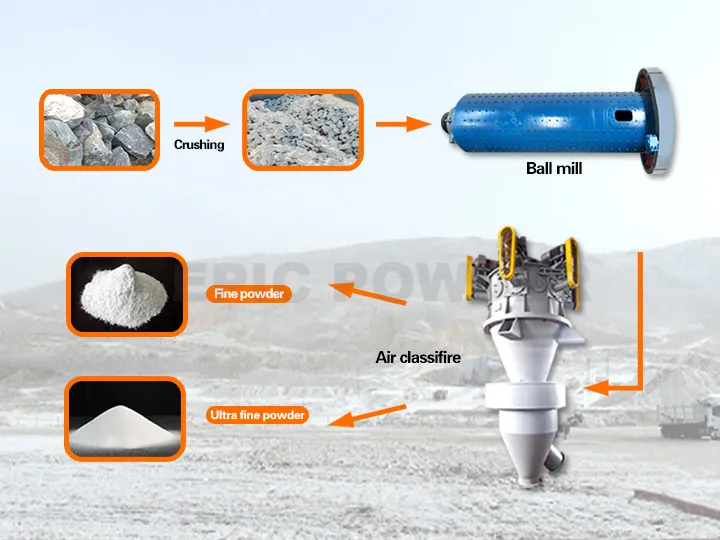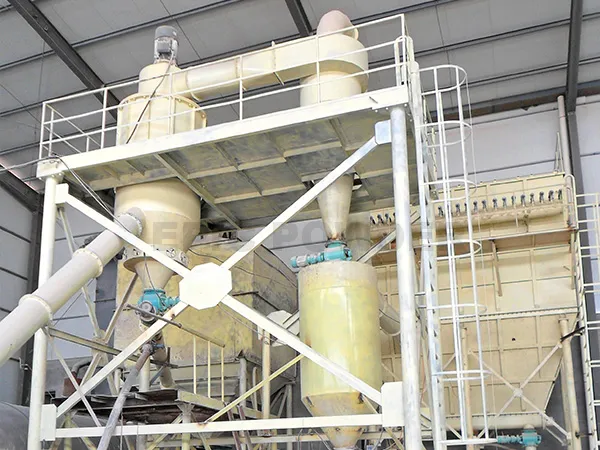
La production industrielle moderne traite généralement le quartz grâce à un système intégré de broyage et de classification, comprenant un broyeur à jet et un classificateur à air. Clarifions le rôle de ces deux équipements clés.
Clarification des concepts fondamentaux : Broyeur à jet vs. Broyeur à classificateur
Broyeur à jet d'air (broyeur à jet d'air) : Son principe de base repose sur la réduction de la taille des particules, ou broyage. Il utilise de l'air comprimé supersonique pour accélérer les particules, provoquant leur collision et leur fragmentation. Point important : un broyeur à jet autonome ne dispose pas d'une fonction de classification précise.
Classificateur d'air : Son principe de base est la séparation. Il sépare les matériaux déjà broyés en fonction de la taille des particules grâce à la force centrifuge et au flux d'air. Le système récupère les particules fines et rejette les particules grossières pour un broyage ultérieur.
Le terme Air Moulin classificateur fait généralement référence à un Broyeur à impact mécanique avec roue de classification intégrée (Par exemple, un broyeur à cylindres verticaux). Ce type d'équipement combine le concassage et le tri préliminaire au sein d'une seule unité.
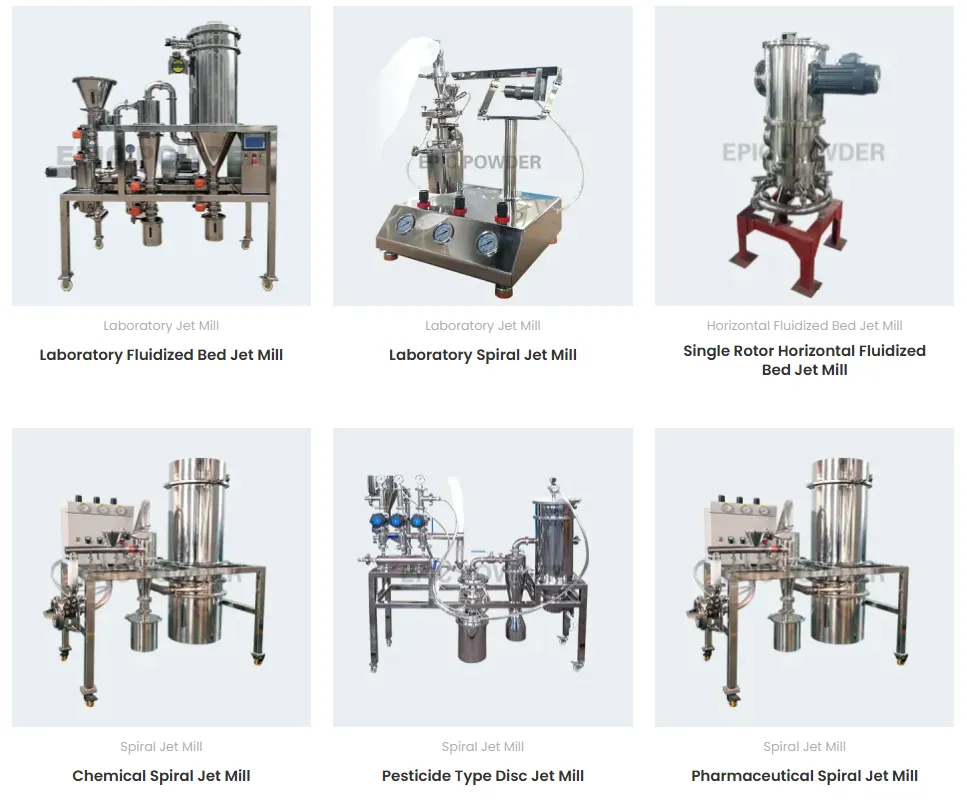
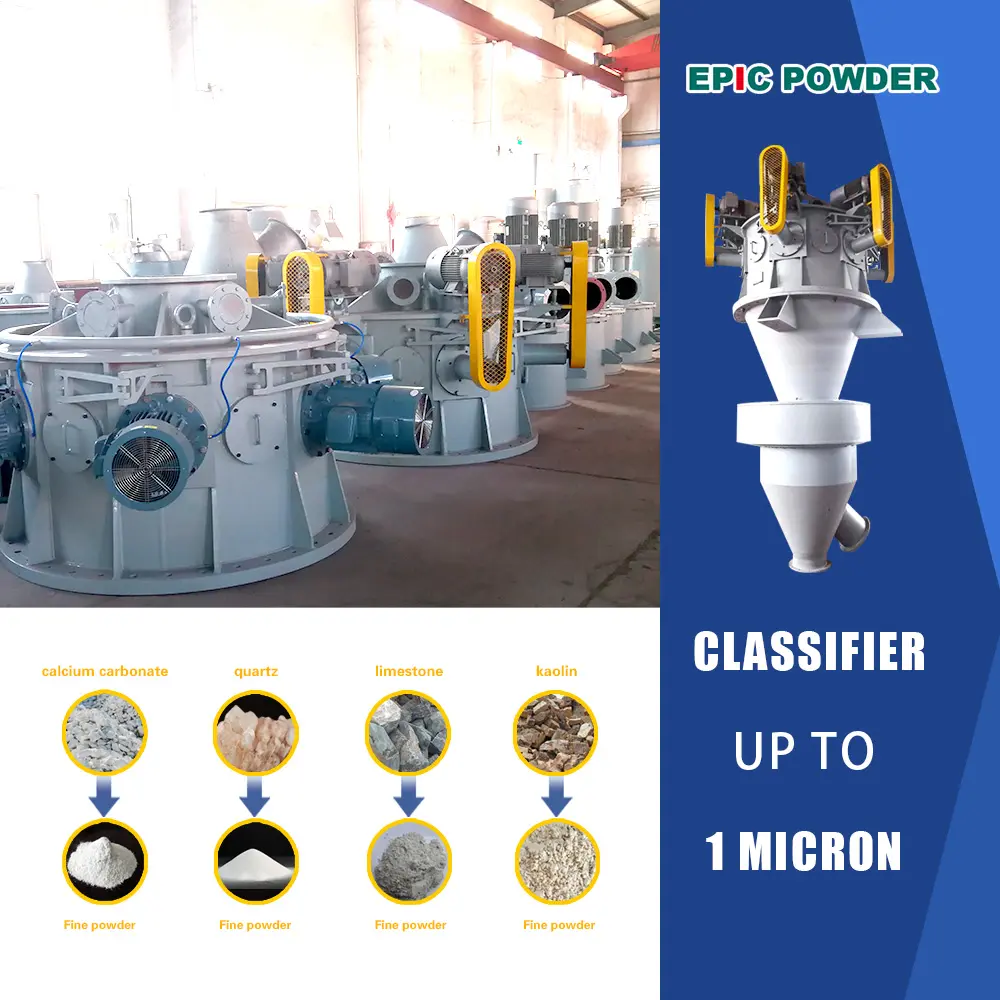
Procédé privilégié pour le quartz : broyeur à jet + système de classification pneumatique
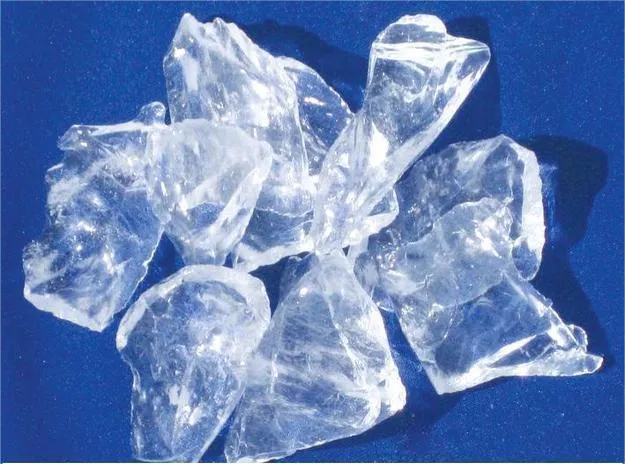
Pour les matériaux durs comme le quartz (dureté Mohs 7) qui nécessitent une pureté stricte et une distribution granulométrique étroite, le système Jet Mill + classificateur d'air dynamique à haute efficacité représente la configuration avancée et courante de l'industrie.
Fonctionnement du système intégré :
- La matière première de quartz pré-broyée est introduite dans la chambre de broyage du broyeur à jet.
- Les tuyères supersoniques accélèrent les particules et les broient principalement par collision entre elles.
- Le flux d'air transporte ensuite le matériau broyé vers un classificateur à air dynamique à haut rendement, généralement monté sur le broyeur ou intégré à celui-ci.
- La roue rotative à grande vitesse du classificateur agit comme un « tamis » précis, ne laissant passer que les fines particules plus petites que le point de coupure cible comme produit final.
- La roue de classification rejette les particules grossières trop grosses et les renvoie automatiquement dans la chambre du broyeur à jet pour un broyage plus poussé.
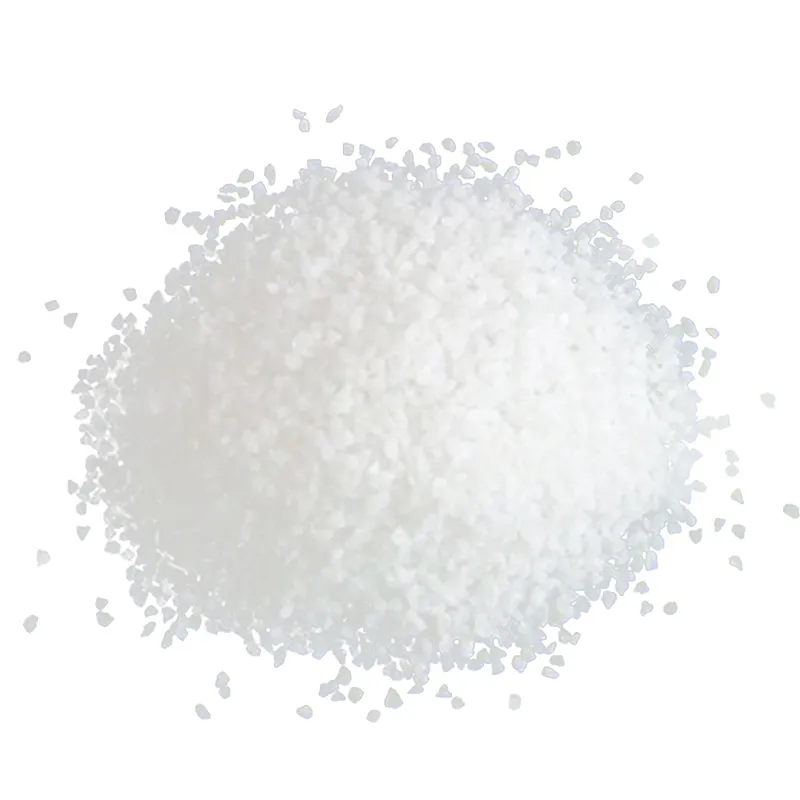
Pourquoi ce système est-il la référence en matière de quartz ?
Pureté élevée garantie : Le broyage par jet d'air est un procédé purement physique, sans pièces de broyage mobiles. Il en résulte une usure minimale du matériel et l'absence de contamination métallique, un point crucial pour le quartz de haute pureté – un avantage considérable par rapport aux broyeurs mécaniques.
Contrôle précis de la taille des particules : Le classificateur pneumatique indépendant à haut rendement permet un contrôle extrêmement précis du point de coupure supérieur (D97) du produit final. Il permet de produire facilement des poudres ultrafines avec une distribution granulométrique étroite et homogène.
Contamination par le fer à faible concentration : Les fabricants peuvent revêtir l'ensemble des surfaces internes du système de céramique, de polyuréthane ou d'autres matériaux résistants à l'usure, ce qui garantit une teneur en fer extrêmement faible dans le produit.
Haute efficacité : Le système en boucle fermée recycle en continu les matériaux surdimensionnés pour un nouveau broyage, maximisant ainsi l'efficacité globale du broyage et évitant le gaspillage d'énergie sur les fines déjà conformes aux spécifications.
Pourquoi ne pas utiliser un broyeur à classification pneumatique autonome ?
Bien que les broyeurs à impact mécaniques avec classificateurs intégrés aient leur utilité (par exemple, pour les minéraux plus tendres comme le carbonate de calcium avec des exigences de pureté moins élevées), ils présentent des inconvénients importants pour le traitement du quartz :
- Risque de contamination : Lors du traitement du quartz dur, les rouleaux, les broches et les tables de broyage d'un broyeur mécanique subissent une usure importante, introduisant du fer et d'autres impuretés métalliques. De ce fait, ils ne conviennent pas aux applications de pointe telles que le photovoltaïque ou le quartz de qualité semi-conducteur.
- Limite de finesse : Pour les poudres très fines (par exemple, D97 < 20 µm), l'énergie de broyage et la précision de classification d'un broyeur classificateur intégré sont souvent inférieures à celles d'un système broyeur-classificateur à jet dédié.
- Usure rapide des composants : Le traitement du quartz provoque une usure importante des pièces consommables de l'usine, ce qui entraîne une augmentation des coûts de maintenance et des temps d'arrêt.
Comparaison sommaire
| Fonctionnalité | Système de broyeur à jet + classificateur d'air | Broyeur à impact mécanique (broyeur classificateur) |
| Principe de fonctionnement | Impact particule-particule + Classification de précision externe | Impact et compression + Classification préliminaire interne |
| Pureté du produit final | Extrêmement élevé, aucune contamination métallique | Risque de contamination par usure plus faible |
| Finesse du produit final | Capable de superfine, distribution étroite poudres | Idéal pour les poudres moyennement fines ; moins efficace pour les poudres très fines. |
| Équipement d'usure | Très faible | Significatif |
| Consommation d'énergie | Supérieur (relatif) | Inférieur (relatif) |
| Idéal pour | Quartz haut de gamme :Semiconducteurs, photovoltaïque solaire, charges de haute qualité | Quartz standard : Construction, corps en céramique, etc. |
Pour la production de poudre de quartz de haute pureté et de grande valeur destinée à des applications telles que les semi-conducteurs, le photovoltaïque et les revêtements avancés, le système intégré de broyage à jet et de classification pneumatique est la solution idéale. Pour les applications standard où la pureté et la granulométrie précise sont moins critiques, un broyeur à impact mécanique économique peut être utilisé.
Poudre épique
En tant qu'innovateur de premier plan dans le domaine des technologies de réduction de taille, Poudre épique Notre entreprise est spécialisée dans la conception et la fabrication de systèmes de broyage de pointe. Nous proposons des solutions personnalisées, notamment le broyeur à jet et le classificateur à air décrits ci-dessus, garantissant une pureté élevée, un contrôle précis de la granulométrie et une efficacité exceptionnelle pour les applications exigeantes telles que le traitement du quartz. N'hésitez pas à nous contacter. mineral@epic-powder.com.

Merci de votre lecture. J'espère que cet article vous sera utile. N'hésitez pas à laisser un commentaire ci-dessous. Vous pouvez également contacter le service client en ligne d'EPIC Powder. Zelda pour toute autre question.
— Jason Wang, Ingénieur principal