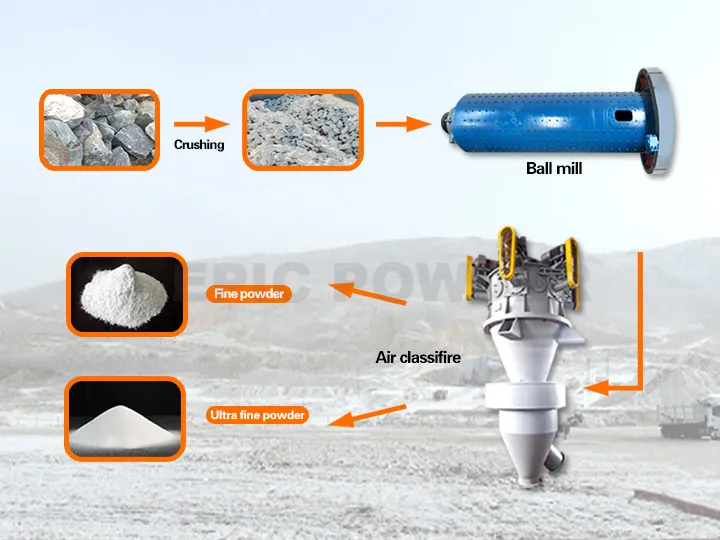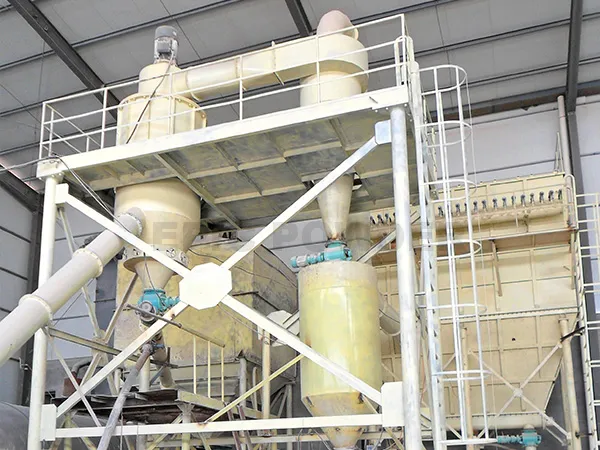
El cuarzo de alta pureza se utiliza ampliamente en industrias como la electrónica y la tecnología de la información, la energía fotovoltaica, las comunicaciones ópticas y las fuentes de luz eléctrica. Ocupa una posición importante y desempeña un papel crucial en industrias estratégicas emergentes como las de nuevos materiales y nuevas energías. La producción de cuarzo de alta pureza se basa en un sistema tecnológico integrado que abarca cuatro aspectos principales: selección de la materia prima, proceso de purificación y equipos de procesamiento, como los especializados. Molino de chorro de cuarzo de alta pureza—y detección de calidad. Estos componentes son interdependientes, pero funcionan como un todo cohesivo. Entre ellos, la identificación, evaluación y selección de materias primas de cuarzo de alta pureza sigue siendo el paso fundamental más crítico.
I. Tecnología de selección de materias primas
La calidad del cuarzo de alta pureza no es simplemente una función lineal del contenido de impurezas, sino que depende de las características mineralógicas de sus impurezas durante el proceso. Los diferentes minerales de cuarzo presentan características y contenidos de impurezas variables. Por lo tanto, para las materias primas de cuarzo de alta pureza, analizar sus características de impurezas es fundamental para determinar el proceso de purificación y su aplicación.
Pureza
La descripción de la pureza de las materias primas de cuarzo silíceo de alta pureza debe incluir tanto el porcentaje de SiO₂ como el contenido de impurezas clave que afectan la purificación. Por lo tanto, el contenido de SiO₂, Al y (Ti+Li) puede servir como índices de evaluación. Las materias primas silíceas de alta pureza se pueden clasificar en dos grados:
Grado de alta pureza: SiO2 ≥ 99,9%, Al ≤ 700×10⁻⁶, Li+Ti ≤ 200×10⁻⁶.
Grado ultrapuro: SiO2 ≥ 99,995%, Al ≤ 35×10⁻⁶, Li+Ti ≤ 10×10⁻⁶.
Impurezas minerales de ganga
Los minerales de ganga afectan principalmente la ley inicial del mineral y el rendimiento de beneficio. En comparación con impurezas difíciles de eliminar, como inclusiones e impurezas reticulares, los minerales de ganga y las impurezas de los límites de grano son relativamente más fáciles de eliminar durante la purificación. Tras su eliminación mediante métodos adecuados, generalmente no afectan la pureza final.
Impurezas de inclusión
Dado que las inclusiones existen en los minerales naturales de cuarzo, solo una pequeña porción de las inclusiones de gran tamaño puede eliminarse sin destruir la estructura cristalina del cuarzo. Las inclusiones son uno de los factores más críticos que afectan la calidad del mineral en bruto. Un exceso de inclusiones, especialmente las inclusiones fluidas/gas-líquidas de grano fino y las inclusiones minerales, puede afectar gravemente el rendimiento del producto. Las impurezas presentes en las inclusiones (p. ej., Ti, Li, K, Na) pueden reducir la pureza, mientras que las pequeñas inclusiones fluidas en el producto final pueden expandirse y coalescer gradualmente a altas temperaturas, lo que afecta el rendimiento. La evaluación del mineral en bruto requiere estudiar el tipo, la morfología, el tamaño y la cantidad de inclusiones.
Inclusiones fundidas compuestas principalmente de elementos principales como Si, Al, Fe, Ca, Na, K, Mg. Generalmente se consideran una fuente principal de impurezas de B y P en el cuarzo pegmatita de granito y una fuente de impurezas de Li.
Las inclusiones fluidas contienen impurezas como Na, K, Al y Ca y son una fuente importante de impurezas de metales alcalinos en el cuarzo. Por lo tanto, seleccionar una materia prima de cuarzo con pocas o ninguna inclusión fluida es clave para producir cuarzo de alta pureza.
Los elementos comunes de impurezas reticulares en el cuarzo incluyen Al, Ti, Li, Na, K, Ge, OH, etc. Su contenido suele superar 1×10⁻⁶, lo que dificulta su eliminación económica mediante beneficio convencional o purificación química. Constituyen un factor importante que afecta la pureza y el rendimiento del producto.
El aluminio es el elemento de impureza más importante para la investigación y el análisis, y sirve como indicador clave de la calidad de la materia prima. Su contenido suele ser el más alto y el más fácil de analizar. Un alto contenido de Al suele asociarse con mayores niveles de Li, K y Na.
El titanio es otro indicador clave. El enlace Ti-O es extremadamente estable, lo que dificulta la extracción económica del Ti, ya sea en la red o en minerales que lo contienen en inclusiones. El cuarzo con un contenido de Ti superior a cierto umbral es difícil de procesar para obtener cuarzo de alta pureza.
II. Tecnología de purificación y procesamiento
La tecnología de beneficio y purificación del cuarzo se divide en dos etapas: purificación física y purificación química. Cada técnica se centra en tipos específicos de impurezas.
Purificación física
Su objetivo es separar el cuarzo de los minerales asociados/de ganga y eliminar las películas superficiales/minerales arcillosos, eliminando las impurezas externas. Sirve como purificación preliminar y base para la purificación química. Las tecnologías clave incluyen: lavado-clasificación-deslamado, depuración, separación por gravedad, separación magnética, flotación, calcinación-templado en agua y clasificación por color.
Purificación química
Su objetivo es eliminar las inclusiones microminerales internas, las inclusiones fluidas y las impurezas reticulares, abordando las impurezas minerales internas. Representa una purificación profunda. Las tecnologías clave incluyen: lixiviación ácida, tostación por cloración, choque térmico (ruptura a alta temperatura), radiación de microondas y métodos microbianos.
Choque térmico y Calcinación-enfriamiento con agua (físico) crea grietas para facilitar la lixiviación ácida de los interiores de las inclusiones. Lixiviación ácida Es una técnica química fundamental común. Tostación por cloración Es altamente eficaz para eliminar impurezas reticulares, una tecnología clave de purificación profunda. Radiación de microondas Tiene como objetivo la eliminación de inclusiones fluidas. métodos microbianos Separación de impurezas de la superficie objetivo.
III. Tecnología de equipos de procesamiento
El procesamiento y la purificación del cuarzo requieren equipos especializados. Los principales tipos de equipos incluyen:
Lavado y clasificación
Se utilizan equipos como clasificadores en espiral, hidrociclones, clasificadores de aire y cribas vibratorias para la clasificación y separación precisas de arena de sílice en diversas industrias.
Trituración y molienda
En esta etapa se utilizan equipos de molienda que incluyen molinos de bolas, molinos de barras, molinos de bolas planetarios verticales, molinos de arena, molinos vibratorios y molinos de chorro.
Separación por gravedad
Este método separa los minerales objetivo de las impurezas aprovechando las diferencias en la forma, el tamaño y la densidad de las partículas, que provocan que los minerales se muevan a diferentes velocidades y trayectorias en un medio como el agua o el aire. Los equipos comunes para la arena de cuarzo incluyen concentradores en espiral, mesas vibratorias y compuertas.
Clasificación por colores
Los clasificadores de color separan las impurezas detectando las diferencias de color: la arena de cuarzo pura es blanca, mientras que las impurezas suelen ser de otros colores. Estos sistemas constan de un sistema de alimentación, un sistema de detección óptica, un sistema de procesamiento de señales y un sistema de ejecución de la separación.
Flotación
Este proceso elimina minerales independientes de la ganga, como el feldespato y la mica. Si bien el cuarzo comparte propiedades físicas y químicas similares con el feldespato, la flotación los separa eficazmente. Los equipos comunes incluyen flotadoras con agitación y flotadoras de barras.
Separación magnética
En un campo magnético, el cuarzo no magnético permanece inalterado, mientras que las impurezas magnéticas son atraídas. La separación se logra gracias a esta diferencia de magnetismo. Los equipos típicos incluyen separadores electromagnéticos de polvo seco, separadores de tambor magnéticos permanentes, separadores de placas magnéticas de alta intensidad, separadores magnéticos de anillo vertical de alto gradiente, separadores electromagnéticos de lodos y separadores magnéticos superconductores.
Separación electrostática
Esta técnica separa minerales mediante la aplicación de un campo eléctrico, donde partículas con diferentes cargas o polaridades se mueven en trayectorias distintas. Como método de beneficio físico consolidado, ofrece un rendimiento fiable, una operación sencilla y reduce eficazmente las impurezas metálicas en el cuarzo de alta pureza, simplificando así el procesamiento posterior.
Lixiviación ácida
Las impurezas de óxido metálico en la arena de cuarzo reaccionan con ácidos mixtos para formar residuos insolubles, que posteriormente se eliminan. Este proceso se realiza generalmente en recipientes sellados de reacción ácida.
Tratamiento térmico
Métodos como el choque térmico (estallido a alta temperatura) y la tostación por cloración se llevan a cabo utilizando equipos especializados como hornos de cloración de alta temperatura o hornos de tostación.
IV. Tecnología de detección de calidad
La investigación sobre la génesis de depósitos, la clasificación de materias primas silíceas y el control de calidad de productos requiere el apoyo de pruebas analíticas. Si bien no existen estándares unificados, los métodos de detección del componente principal, el SiO₂, se dividen en dos categorías:
Métodos de análisis químico
Incluye métodos gravimétricos (coagulación con cola animal, coagulación con polioxietileno, deshidratación con ácido perclórico, volatilización directa con tetrafluoruro de silicio), titulación con fluorosilicato de potasio, espectrofotometría con azul de silicio y molibdeno, y método volumétrico con fluorosilicato de potasio. La coagulación con polioxietileno y la coagulación con cola animal son métodos estándar a nivel nacional debido a su alta precisión.
Métodos de análisis instrumental
Incluye espectrometría de fluorescencia de rayos X (XRF), espectrometría de emisión óptica de plasma acoplado inductivamente (ICP-OES) y espectrometría de masas de plasma acoplado inductivamente (ICP-MS).
Aplicación de molinos de chorro en el procesamiento de cuarzo de alta pureza
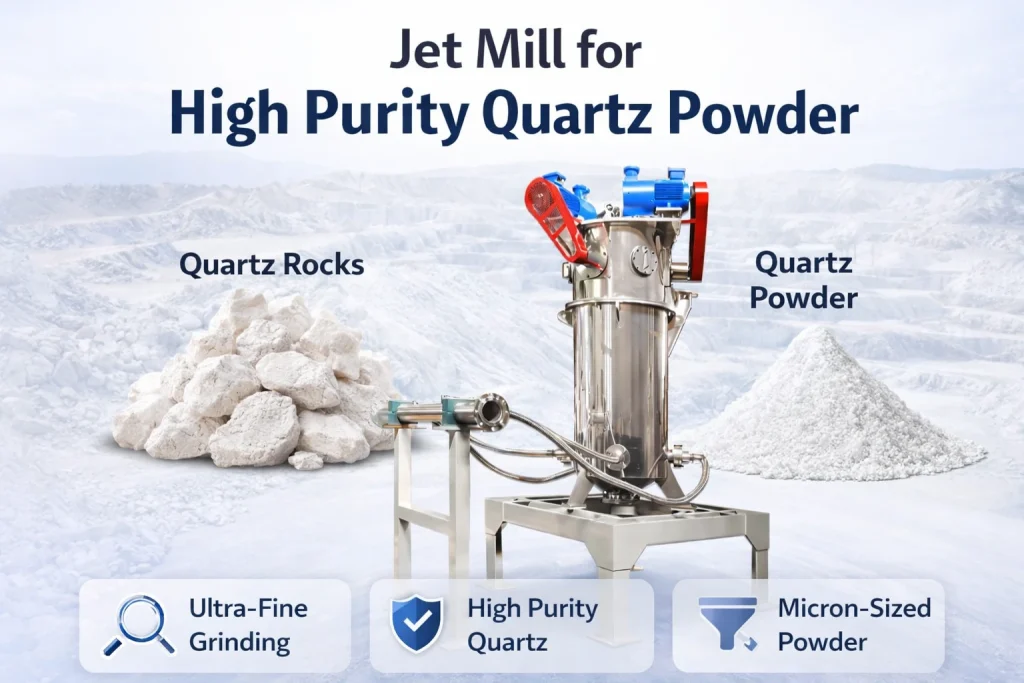
El molino de chorro, en particular el de lecho fluidizado, es un equipo fundamental para la molienda ultrafina de cuarzo de alta pureza. Utiliza corrientes de gas a alta velocidad para provocar la colisión y abrasión de las partículas de cuarzo, logrando una pulverización sin desgaste mecánico. Este proceso evita por completo la contaminación metálica, cumpliendo a la perfección con los estrictos requisitos de baja pureza del cuarzo de alta pureza. Su sistema de clasificación integrado permite separar el polvo fino cualificado en tiempo real, garantizando una distribución granulométrica (PSD) concentrada, crucial para la posterior purificación química y aplicaciones de alta gama. Mediante el control preciso de parámetros como la presión del aire y la velocidad de la rueda clasificadora, se puede obtener un polvo ultrafino ajustable con un D50 de entre 5 y 20 micras, satisfaciendo así las necesidades específicas de campos como el encapsulado de semiconductores y la fabricación de crisoles de cuarzo de alta gama.
El papel crucial de los clasificadores de aire
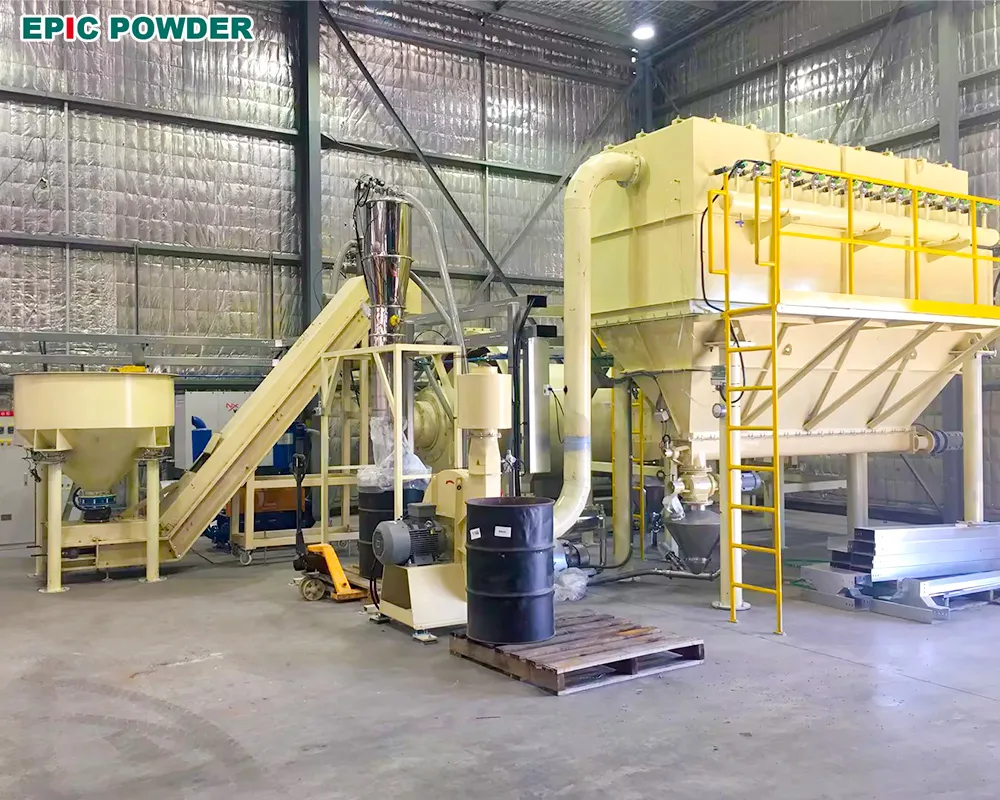
En la clasificación de precisión de cuarzo de alta pureza, los clasificadores de aire, especialmente los turboclasificadores de alta eficiencia, desempeñan un papel fundamental. No funcionan simplemente mediante un cribado, sino aprovechando el equilibrio preciso entre la fuerza centrífuga y la resistencia aerodinámica para lograr una clasificación eficiente y precisa de polvos de cuarzo micrométricos e incluso submicrónicos. Este equipo elimina eficazmente las partículas gruesas y los finos ultrafinos generados por la molienda excesiva, controlando estrictamente los límites de tamaño superior e inferior del producto. Esto mejora la fluidez y la densidad de empaquetamiento del polvo. Al integrarse con un molino de chorro para formar un sistema de circuito cerrado, crea un eficiente proceso integrado de "molienda y clasificación", que mejora significativamente la eficiencia de producción y la consistencia del producto. Esta combinación es clave para lograr una producción escalable y de alta calidad de cuarzo de alta pureza.
La combinación de molinos de chorro y clasificadores de aire no solo mejora la precisión de la trituración física, sino que también crea condiciones favorables para la purificación química posterior. Las partículas uniformes y refinadas aumentan la superficie específica, lo que facilita la penetración de las soluciones ácidas. Esto mejora drásticamente la eficiencia de la lixiviación ácida en la eliminación de inclusiones e impurezas superficiales. Simultáneamente, el control preciso del tamaño de partícula evita los problemas del proceso causados por polvo excesivamente fino en las etapas posteriores (p. ej., tortas de filtración demasiado densas, lavado difícil). Por lo tanto, este sistema no es simplemente una herramienta de procesamiento físico, sino un elemento estratégico para optimizar el proceso de purificación general y mejorar la pureza y el rendimiento del producto final.
Conclusión
Con el rápido desarrollo de los campos de alta tecnología, la importancia estratégica del cuarzo de alta pureza es cada vez más prominente, lo que impulsa requisitos de calidad cada vez más estrictos.
La producción de cuarzo de alta pureza es un proyecto de ingeniería sistemático que se basa en tecnologías integradas que abarcan la selección de recursos, las técnicas de procesamiento/purificación, el nivel de equipos de producción y las capacidades de inspección/análisis. Es un todo interconectado. La evaluación de las materias primas no puede basarse únicamente en el contenido de SiO₂. Se deben considerar las características de diseminación del mineral, los tipos de ganga asociados, el contenido/tamaño de las inclusiones y la distribución isomorfa de impurezas. Estas características guían la selección de los procesos de purificación y equipos de procesamiento adecuados.
Polvo épico
Polvo épico Epic Powder cuenta con más de 20 años de experiencia en el procesamiento de diversos polvos. Ofrecemos una amplia gama de modelos de equipos y soluciones a medida para satisfacer sus necesidades específicas. Nuestro equipo cuenta con más de 20 años de experiencia en el procesamiento de diversos polvos. Epic Powder se especializa en tecnología de procesamiento de polvo fino para las industrias minera, química, alimentaria y farmacéutica, entre otras. ¡Contáctenos hoy mismo para una consulta gratuita y soluciones personalizadas!

Gracias por leer. Espero que mi artículo te haya sido útil. Deja un comentario abajo. También puedes contactar con el servicio de atención al cliente de EPIC Powder en línea. Zelda para cualquier otra consulta.
— Emily Chen, Ingeniero sénior