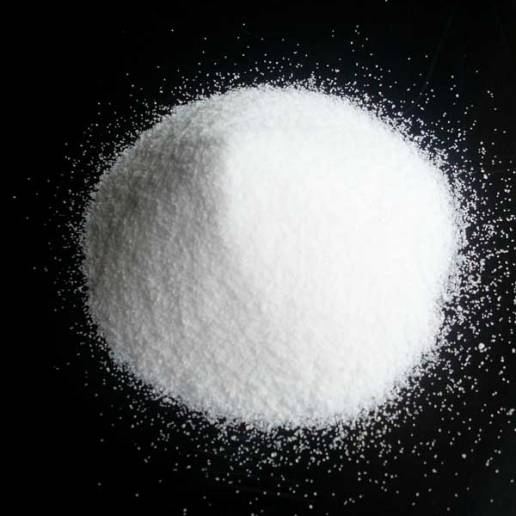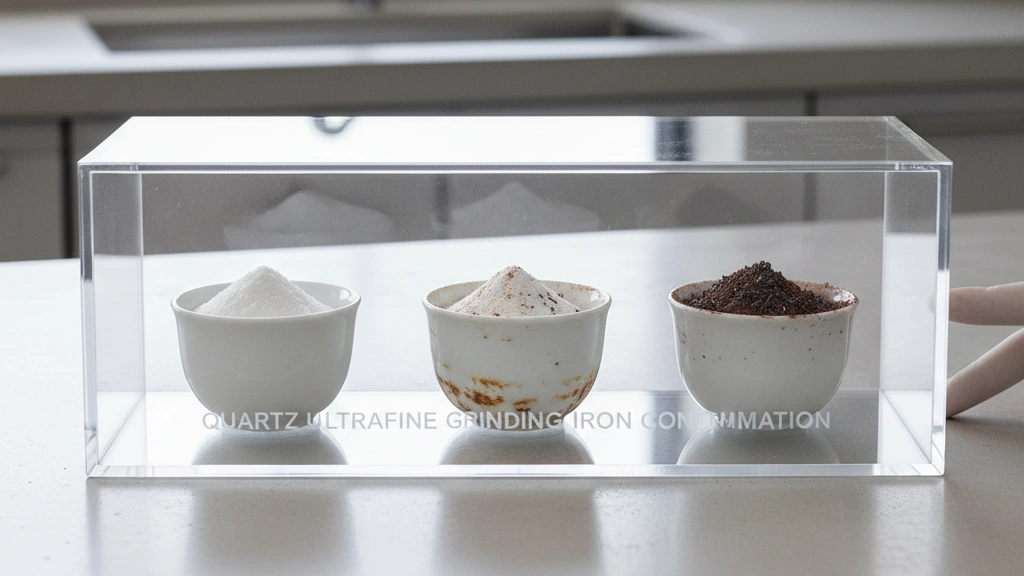
Planning to invest in a quartz grinding production line? The two questions that matter most are: what will it cost, and what drives that cost? Here is the range: a complete quartz grinding and classification production line typically runs from $80,000–$600,000+, depending on capacity, target fineness, purity requirements, and equipment configuration. A single machine (jet mill or ball mill) starts around $30,000. A fully automated, ceramic-lined, high-purity line for semiconductor-grade quartz powder can exceed $1 million.
These ranges are for reference only. Final price is determined by production capacity. The same ball mill + classifier line at 0.5 t/h versus 10 t/h can differ in price by more than 5x. Higher capacity means larger equipment, more complex auxiliary systems, and naturally higher investment. The first step to an accurate quote is defining your capacity requirement. This guide breaks down every cost component, explains what drives price up or down, and helps you estimate a realistic budget before you request a quote.
Table of Contents
1. Quartz Grinding Production Line Cost Breakdown
2. Main Equipment and Price Ranges
3. 6 Key Factors That Determine Your Total Cost
4. Total Cost of Ownership: Beyond the Purchase Price
5. How to Plan Your Budget by Application
6. Why a Free Grinding Test Saves You $10,000+
7. Cost FAQ
1. Quartz Grinding Production Line Cost Breakdown
A quartz grinding production line is not a single machine. It is an engineered system. Here is where your money goes:
| Cost Component | Typical Share of Total | Notes |
| Main grinding equipment (ball mill or jet mill) | 35–50% | The largest cost driver. Jet mills cost more than ball mills at the same capacity. |
| Clasificador de aire | 15–25% | Essential for precise particle size control (D97, D50). Available in horizontal or vertical types. |
| Auxiliary equipment (feeder, cyclone, dust collector, blower, conveyor) | 15–20% | Dust collection is critical for quartz. Silica dust compliance is non-negotiable. |
| Control system (PLC automation) | 5–10% | Full automation reduces labor cost and ensures consistency. |
| Installation, commissioning, and training | 5–8% | On-site or remote guidance. Typically 1–2 weeks. |
| Shipping and customs | 3–7% | Sea freight from China. Varies with destination port and container count. |
| Spare parts (first-year inventory) | 2–5% | Nozzles (jet mill), grinding media (ball mill), liners, classifier wheel. |
2. Main Equipment and Price Ranges
EPIC Powder Machinery offers three core equipment types for quartz grinding. Below are indicative price ranges based on common configurations. Actual prices depend on your material test results and specification requirements.
2.1 Ball Mill + Air Classifier Línea de producción
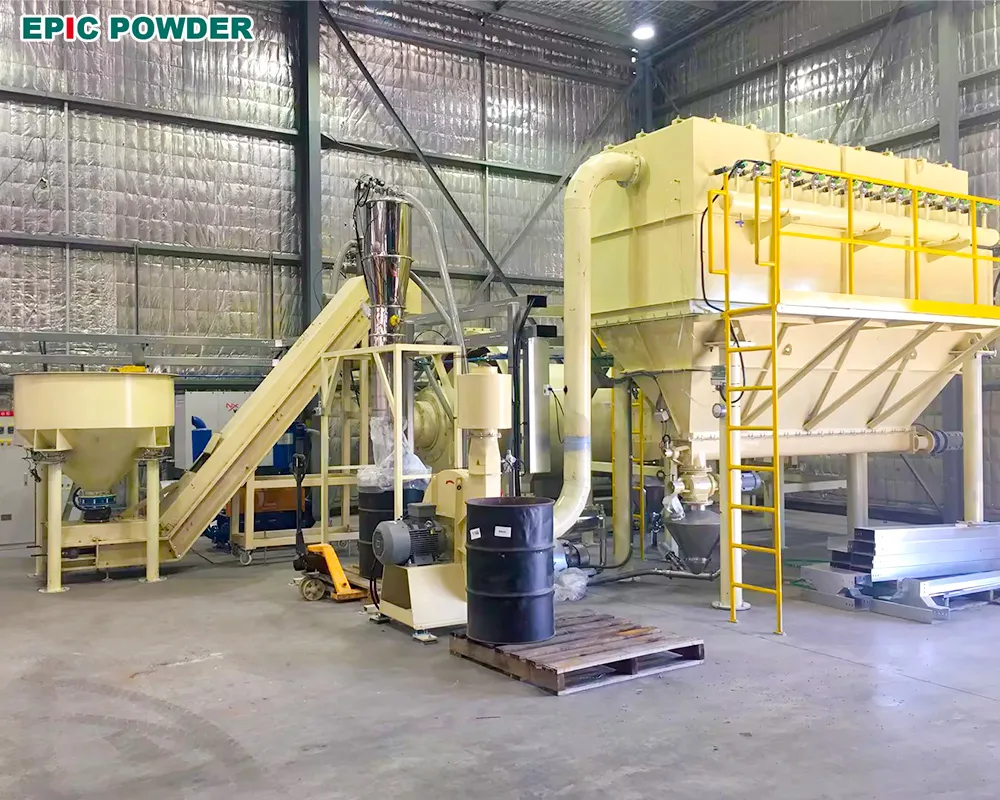
Price range: $80,000–$350,000
The most cost-effective solution for producing quartz powder. The ball mill grinds the quartz, and the air classifier separates the powder to your target particle size distribution. Ball mill power ranges from 75 kW–2,000 kW, with lining options of alumina, silex, or steel. This is the workhorse of the quartz powder industry.
Best for: Medium to large capacity (0.5–10 t/h), standard purity applications
Target fineness: D97 = 5–75 μm
Lining options: Alumina (low iron contamination), silex (low iron contamination), steel (economical)
2.2 Molino de chorro de lecho fluidizado
Price range: $60,000–$300,000
Uses compressed air to create high-velocity collisions between quartz particles. No moving grinding media means zero iron contamination, which is essential for high-purity and ultrafine applications.
Best for: High-purity quartz powder (99.99%+), ultrafine grinding
Target fineness: D97 = 3–45 μm
Key advantage: Ceramic lining available for semiconductor-grade applications
2.3 Air Classifier (standalone)

Price range: $20,000–$80,000
Both horizontal and vertical air classifiers are available. Used to grade quartz powder to precise cut points, or to upgrade existing grinding lines that lack classification.
Best for: Adding precision to an existing line; producing multiple grades from one feed
Cut point range: D97 = 3–150 μm
3. 6 Key Factors That Determine Your Total Cost
Factor 1: Target Particle Size (Fineness)
This is the #1 cost driver. The ball mill + classifier line covers D97 = 5–75 μm. Grinding below D97 = 5 μm requires a jet mill, multiple classification stages, and significantly more energy. As a rule of thumb:
D97 = 45–75 μm: Ball mill + classifier. Standard cost, highest capacity.
D97 = 5–45 μm: Ball mill + classifier (optimized). Medium cost.
D97 = 3–10 μm: Jet mill + classifier. Higher cost, higher energy, but zero contamination.
Factor 2: Purity Requirements and Iron Contamination Control
Purity and iron contamination control are fundamentally linked and must be planned together. If your end product is for general filler applications (paint, rubber, ceramics), standard steel lining is sufficient. If you need high-purity quartz powder for semiconductor packaging, EMC, or copper-clad laminates, you need:
a. Alumina or silex lining (adds 15–30% to equipment cost)
b. Non-metallic grinding media
c. Metal separator
d. Purity testing equipment
The lower the allowed iron content, the more you pay for contamination-prevention engineering. EPIC ball mills offer three lining options, from lowest to highest cost: steel, silex, and alumina.
Factor 3: Production Capacity (t/h)
Capacity is the core factor that determines the final price. Capacity scales cost, but not linearly. Doubling capacity does not double the price because larger equipment is more efficient per ton. Typical ranges:
0.5–2 t/h: Small line, entry-level investment
2–5 t/h: Medium line, most common for commercial quartz powder producers
5–10 t/h: Large line, significant scale economies
Factor 4: Automation Level
A manually operated line saves $10,000–$30,000 upfront but costs more in labor, inconsistency, and quality issues over time. A fully PLC-controlled line with real-time particle size monitoring ensures consistent output and reduces operator dependency. This is critical when your buyers specify tight D97 tolerances.
Factor 5: Dust Collection and Environmental Compliance
Crystalline silica dust is a regulated workplace hazard. Your production line must meet dust emission standards. EPIC lines operate under negative pressure with high-capacity dust collectors achieving up to 99% dust removal. This is not optional. It is a compliance and worker safety requirement.
Factor 6: Shipping, Installation, and Training
Equipment is shipped by sea from Qingdao, China. Installation guidance is provided either on-site or remotely. Budget for 1–2 weeks of commissioning. EPIC provides comprehensive installation guidance and operator training as part of the project.
4. Total Cost of Ownership: Beyond the Purchase Price
The purchase price is only 40–60% of what you will spend over a 10-year period. Here is what experienced quartz powder producers know:
Consumo de energía
Grinding quartz (Mohs hardness 7) is energy-intensive. Jet mills consume the most energy (compressed air), and ball mills are mid-range. Over 10 years, energy cost can equal or exceed the equipment purchase price. Always compare kWh per ton of finished powder, not just equipment price.
Wear Parts and Maintenance
| Equipo | Wear Part | Replacement Interval |
| Molino de chorro | Nozzles | 3–6 months (depends on material hardness) |
| Molino de bolas | Grinding media + liners | 6–12 months |
| Clasificador de aire | Classifier wheel + bearings | 12+ months |
Product Consistency and Yield
A cheaper line without a proper classifier may produce powder that meets spec on average but has a wide particle size distribution. This means oversize particles that your buyer rejects and undersize fines that waste energy. A well-matched ball mill + classifier line can improve yield by 15–30% compared to open-circuit grinding.
5. How to Plan Your Budget by Application
Different end applications require different equipment, which means different budgets. Use this as a starting framework:
Budget Tier 1: General Industrial Filler ($80,000–$150,000)
Solicitud: Quartz powder for paint, rubber, plastics, construction materials
Typical spec: D97 = 45–75 μm, Fe₂O₃ < 0.05%
Recommended: Ball mill + vertical air classifier line, steel lining, semi-automatic control
Budget Tier 2: Engineered Stone and Advanced Filler ($150,000–$300,000)
Solicitud: Engineered quartz stone, coatings, adhesives, specialty ceramics
Typical spec: D97 = 5–25 μm, controlled particle size distribution, surface modification option
Recommended: Ball mill + classifier line with silex lining, PLC control, surface modification system
Budget Tier 3: Electronic Grade and High-Purity ($300,000–$600,000+)
Solicitud: EMC (epoxy molding compound), copper-clad laminates, semiconductor packaging, fused silica
Typical spec: D97 = 3–10 μm, Fe₂O₃ < 0.005%, spherical or angular powder
Recommended: Jet mill + air classifier with full ceramic lining, metal separator, automated particle size monitoring, cleanroom-compatible configuration
6. Why a Free Grinding Test Saves You $10,000+
The single most important cost-saving step in your buying process: send your quartz raw material for a grinding test before you buy.
Why this matters:
Particle size data: You get the actual D50, D90, D97, and particle size distribution for your specific ore, not a generic spec sheet.
Equipment matching: The test determines which equipment (ball mill or jet mill) is genuinely optimal for your material and target fineness. Buying the wrong equipment costs far more than the test.
Energy estimation: Real kWh/ton data lets you calculate operating cost accurately before committing.
Purity verification: The test reveals iron contamination levels, whiteness retention, and whether ceramic lining is necessary.
Capacity confirmation: You get a real throughput figure (t/h) at your target fineness, not a theoretical maximum.
EPIC Powder Machinery offers free material grinding tests. With a database of 5,000+ test reports across 1,000+ different materials, we run your quartz sample through the appropriate equipment and provide a full particle size report and equipment recommendation before you invest.
Get a Free Grinding Test for Your Quartz Material
Send us your raw quartz sample. We will grind it, classify it, and send you a complete particle size report with equipment recommendations and a quotation tailored to your exact requirements.
Request Your Free Test →
7. Quartz Grinding Equipment Cost FAQ
How much does a ball mill + classifier production line cost?
A standard ball mill + air classifier production line for quartz powder ranges from $80,000–$350,000, depending on capacity (0.5–10 t/h), target fineness (D97 = 5–75 μm), lining material (steel, silex, or alumina), and automation level. Ball mill power ranges from 75 kW–2,000 kW, covering small to large capacity needs.
Why is a jet mill more expensive than a ball mill?
A jet mill uses compressed air for grinding with no moving media. This eliminates iron contamination entirely, which is essential for high-purity applications. However, it requires a larger air compressor and consumes more energy per ton. You are paying for purity, not just grinding.
How much does capacity affect the price?
Capacity is the biggest variable in final price. The same ball mill + classifier line at 0.5 t/h may start around $80,000, while a 10 t/h line can exceed $350,000. Doubling capacity typically increases price by 50–70%, not 100%, because larger equipment is more cost-efficient per ton. To get an accurate quote for your capacity, tell us your target throughput (t/h) and we will provide a detailed quotation based on your material test data.
What is the production lead time?
EPIC equipment is custom-manufactured to your specifications. The production cycle is approximately 1–2 months after contract signing, plus shipping time by sea.
¿Ofrecen servicio de instalación?
Yes. EPIC provides both on-site and remote installation guidance. A technical team supports you from equipment receipt through production startup.
Can you guarantee my required particle size and purity?
We confirm this through a material test before manufacturing. The test report shows the actual D97, D50, and particle size distribution for your quartz. Equipment is then designed and configured to meet these confirmed specifications, not theoretical estimates.
What about spare parts?
Each equipment shipment includes one set of consumable parts as standard. Additional spare parts (nozzles, grinding media, liners, classifier wheels) can be purchased with the initial order. Wear part replacement intervals are typically 3–6 months for jet mill nozzles and 6–12 months for ball mill media, depending on material hardness.
Is the equipment certified?
Yes. EPIC equipment carries EU CE safety certification and ISO 9001:2015 quality management certification, meeting the requirements of multiple industries.
Ready to Get an Accurate Quote?
You now know the cost structure, the key factors, and the budget tiers. The next step is simple:
1. Send your quartz sample (5–10 kg is sufficient)
2. Tell us your target: Target capacity (t/h) is the key information that directly determines equipment specs and final price. Also include particle size (D97), purity requirement (Fe₂O₃ max), and end application.
3. Receive: a test report, equipment recommendation, and detailed quotation.
This costs you nothing and gives you the exact numbers you need for your investment decision.
Contact EPIC Powder Machinery for Your Quartz Grinding Project →
EPIC Powder Machinery, finer material for a better world. 20+ years in powder equipment. CE and ISO 9001:2015 certified. 5,000+ test reports. Exported to 10+ countries. Custom-engineered quartz grinding solutions from Qingdao, China.
Gracias por leer. Espero que mi artículo te haya sido útil. Deja un comentario abajo. También puedes contactar con el servicio de atención al cliente de EPIC Powder en línea. Zelda para cualquier otra consulta.
— Emily Chen, Ingeniero