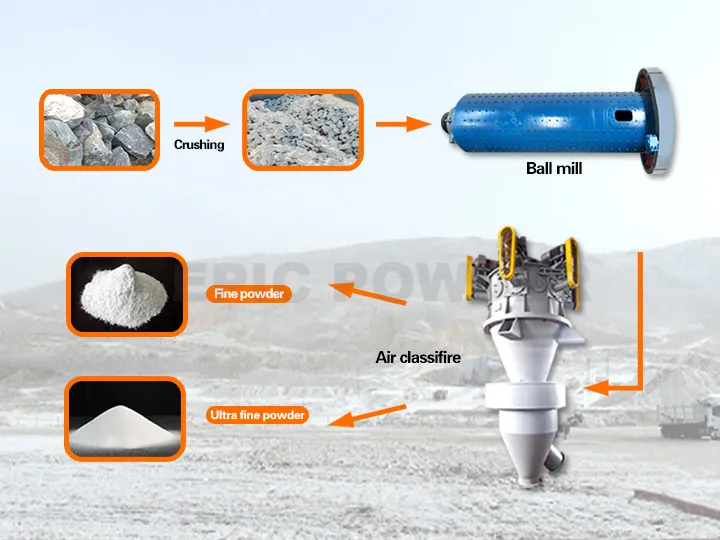
Le quartz est l'un des minéraux industriels les plus transformés, pourtant sa dureté (Mohs 7) et l'abrasivité font du broyage fin un véritable défi technique. Pour les producteurs de poudre de quartz de haute pureté, l'objectif n'est pas simplement de réduire la taille des particules, mais d'obtenir une distribution granulométrique étroite et reproductible sans introduire de contamination métallique.
Chez EPIC Powder, nous avons conçu un système de broyage et de classification répondant à ces exigences. En combinant un broyeur à jet à lit fluidisé avec un classificateur à air de haute précision, nous produisons de manière constante des fines de quartz à partir de ces matériaux. D97 3 µm à 45 µm, avec une coupure nette à D97 10 µm pour la fraction fine et D50 18 µm pour la fraction grossière. Tout ceci est réalisé à un débit stable de 800 kg/h, ce qui rend la ligne adaptée à la fois à la production spécialisée et à la production à l'échelle industrielle.
Pourquoi un broyeur à jet est le bon choix pour le quartz
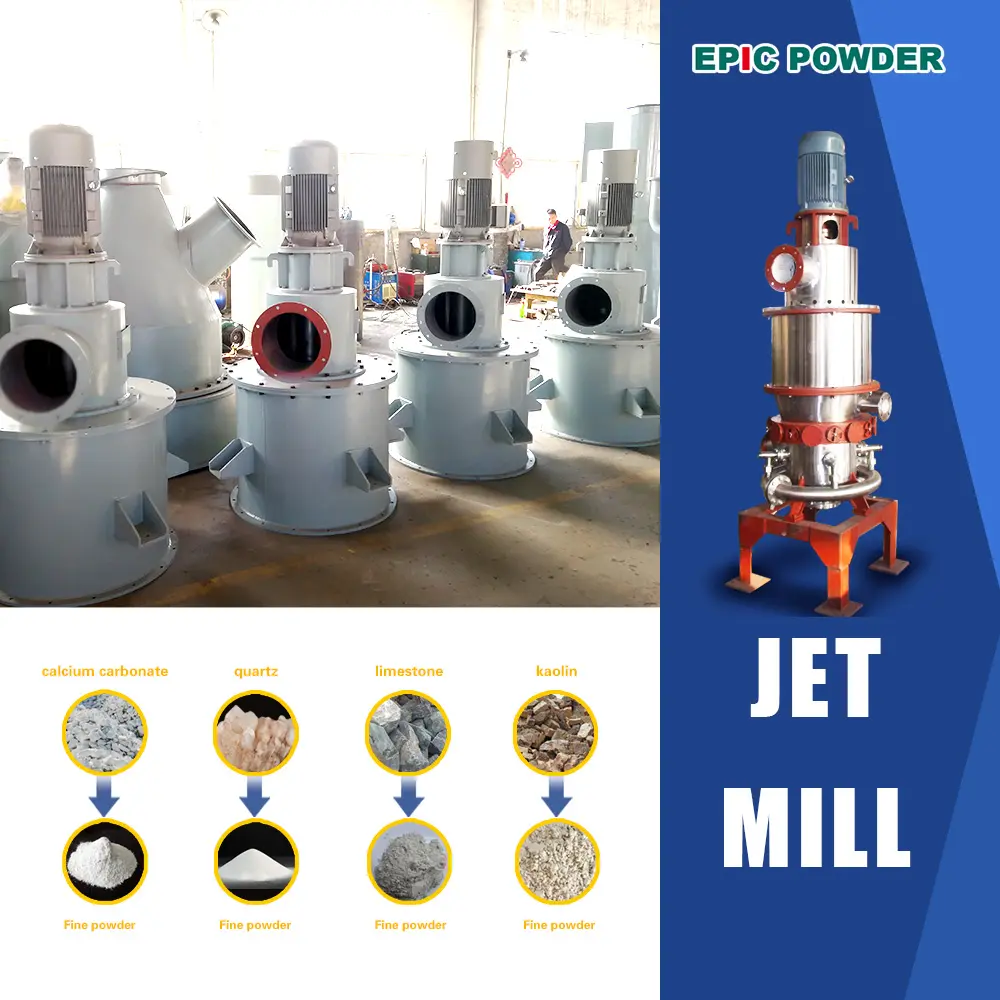
Contrairement aux broyeurs à boulets ou aux broyeurs à marteaux, un broyeur à jet à lit fluidisé Ce procédé n'utilise aucun média de broyage mobile. L'air comprimé accélère les particules de quartz à grande vitesse, provoquant leur collision. Ce principe d'auto-broyage offre deux avantages majeurs pour le traitement du quartz.
Premièrement, il y a aucun contact métal-particuleLe risque de contamination par le fer est ainsi pratiquement éliminé. Pour la silice fondue de qualité électronique ou les charges d'encapsulation de semi-conducteurs, il est essentiel de maintenir la teneur en Fe₂O₃ en dessous de 30 ppm, et un broyeur à jet permet d'atteindre cet objectif.
Deuxièmement, le broyage est remarquablement uniforme. Le temps de séjour des particules dans la chambre de broyage est court, ce qui minimise le surbroyage. Par conséquent, la distribution granulométrique est naturellement plus abrupte qu'avec un broyeur à boulets. Avec un broyeur à jet EPIC, vous pouvez obtenir une large gamme de finesses. D97 3 µm (très fin) jusqu'à D97 45 µm (partie plus grossière), simplement en ajustant la pression de broyage et la vitesse du classificateur.
Le rôle crucial du classificateur d'air
Un broyeur à jet peut à lui seul broyer du quartz, mais sans un classificateur efficace, il est impossible de séparer la fraction fine recherchée des particules grossières. C'est là que le classificateur à air intégré devient indispensable.
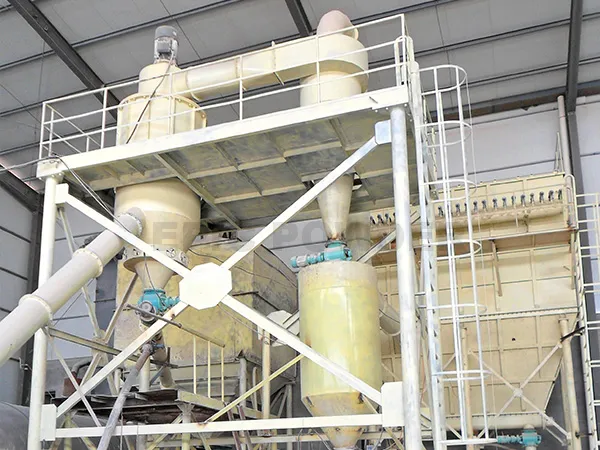
Dans notre système, le classificateur d'air Le procédé fonctionne en circuit fermé avec le broyeur à jet. Après broyage, le matériau pénètre dans le classificateur, où des roues rotatives à grande vitesse créent un champ de force centrifuge. Les particules fines sont attirées vers le centre et collectées comme produit, tandis que les particules grossières sont renvoyées dans la chambre de broyage pour un second passage.
Cette configuration nous permet d'obtenir un résultat très séparation nette au point de coupure cible. Pour une application typique sur quartz, nous configurons le classificateur pour produire :
| Flux de produits | Finesse cible | Cas d'utilisation typique |
|---|---|---|
| Fraction fine | D97 ≤ 10 µm | Encapsulation CEM, sous-remplissage de semi-conducteurs |
| Fraction grossière | D50 ≈ 18 µm | Stratifiés pour circuits imprimés, charges à haute fluidité, moulage |
Les deux fractions sont produites simultanément à partir de la même matière première, ce qui permet au transformateur d'obtenir deux produits commercialisables à partir d'une seule ligne de production.
Aperçu des principaux paramètres techniques
Le tableau suivant résume les spécifications de performance obtenues lors du broyage de quartz de haute pureté (taille d'alimentation < 100 mesh, SiO₂ ≥ 99,5%) sur un système de broyeur à jet EPIC et de classificateur fonctionnant à 800 kg/h.
| Paramètre | Valeur atteinte |
|---|---|
| Plage de finesse de broyage (broyeur à jet seul) | D97 3 – 45 µm |
| Fraction fine après classification | D97 ≤ 10 µm |
| Fraction grossière après classification | D50 ≈ 18 µm |
| Débit continu et stable | 800 kg/h |
| Teneur typique en fer (Fe₂O₃) | < 30 ppm |
Ces valeurs ne sont pas des maximums théoriques ; elles sont couramment obtenues lors des installations chez les clients en Europe et en Asie.
Avantages pratiques des processeurs à quartz
Lorsque vous exploitez une ligne de broyage à jet et de classification à air à 800 kg/h, les avantages économiques et techniques s'accumulent rapidement.
Vous gagnez en flexibilité d'application. La même ligne de production peut aujourd'hui fournir de la poudre D97 de 10 µm pour le marché de l'électronique et être adaptée demain pour produire de la poudre D97 de 25 µm destinée aux charges pour peintures. Vous pouvez ainsi répondre aux besoins de plusieurs segments de clientèle sans investir dans des machines supplémentaires.
Vous préservez la pureté du produit. Grâce à sa conception sans billes de broyage métalliques et à ses meules de classification protégées contre l'usure, la poudre de quartz finale est pratiquement exempte de contamination métallique. Il s'agit d'une exigence essentielle pour les applications électroniques et optiques de pointe.
Vous réduisez vos coûts énergétiques et d'entretien. Un broyeur à jet ne comporte ni média de broyage à remplacer, ni tamis à déboucher, ni marteaux à rectifier. Les principales pièces d'usure sont la roue de classification et la bague de buse, conçues pour une longue durée de vie et un remplacement aisé. Comparée à un broyeur à boulets produisant la même finesse, une ligne de broyage à jet consomme généralement de 20 à 300 tonnes d'énergie en moins par tonne.
Applications typiques de la poudre de quartz produite
Les deux flux de produits issus de ce système desservent des marchés différents mais d'égale valeur.
Le fraction fine (D97 ≤ 10 µm) Ce matériau est idéal pour les composés de moulage époxy (EMC) utilisés dans l'encapsulation des semi-conducteurs, ainsi que pour les matériaux de remplissage haute performance et certaines applications de revêtement optique. Dans ces applications, la fine poudre de quartz agit comme une charge fonctionnelle qui doit s'écouler facilement et ne pas endommager les composants fragiles.
Le fraction grossière (D50 ≈ 18 µm) Ce matériau est particulièrement adapté aux stratifiés pour circuits imprimés (PCB), où une granulométrie légèrement supérieure améliore les propriétés diélectriques et la résistance mécanique du circuit. Il est également utilisé dans le moulage de céramiques et comme charge à haute fluidité pour les adhésifs industriels.
Si vous avez besoin d'un produit plus grossier, le système peut être ajusté pour produire des valeurs D97 allant jusqu'à 45 µm, couramment utilisées dans les peintures, les revêtements et les matériaux de construction.
Foire aux questions
Q1 : Votre broyeur à jet peut-il broyer du quartz jusqu'à D97 en dessous de 5 microns ?
Oui. Le broyeur à jet à lit fluidisé EPIC est capable d'atteindre D97 aussi faible que 3 µm Lors du traitement du quartz de haute pureté, nous augmentons la pression de broyage à 8-9 bars et la vitesse de la meule de classification. Cependant, pour les valeurs D97 inférieures à 5 µm, nous recommandons une classification en deux étapes, car elle permet d'obtenir une distribution granulométrique plus précise et d'éviter les pertes d'efficacité liées au broyage ultrafin en une seule étape. Si votre objectif est systématiquement inférieur à 5 µm, veuillez nous contacter afin de discuter d'une configuration personnalisée.
Q2 : Comment éviter la contamination par le fer lors du broyage du quartz ?
Notre système prévient la contamination par le fer de deux manières. Premièrement, le broyeur à jet utilise un principe d'auto-affûtage Les particules entrent en collision entre elles, et non avec des surfaces métalliques. De plus, toutes les pièces internes en contact avec le quartz, notamment la roue de classification et le revêtement de la chambre de broyage, sont soit en céramique, soit revêtues de matériaux résistants à l'usure. Par conséquent, la teneur typique en Fe₂O₃ dans la poudre finale est de moins de 30 ppm, qui répond aux exigences des charges de quartz de qualité électronique et de qualité semi-conducteur.
Q3 : Puis-je produire à la fois de la poudre de quartz fine et grossière à partir de la même ligne de production ?
Absolument. C'est l'un des principaux avantages d'un classificateur pneumatique intégré. Le classificateur sépare en continu les matériaux broyés en deux flux : un fraction fine (D97 ≤ 10 µm) qui est collecté comme produit principal, et un fraction grossière (D50 ≈ 18 µm) est collecté séparément comme sous-produit. À un débit de 800 kg/h, on obtient généralement 65% de poudre fine et 30% de poudre grossière, avec seulement 5% environ recyclés. Cela génère deux sources de revenus à partir d'une seule ligne de production, améliorant considérablement la rentabilité globale.
Conclusion
Le broyage du quartz pour obtenir une granulométrie précise et reproductible ne signifie pas nécessairement accepter la contamination ou un faible débit. Grâce à un broyeur à jet à lit fluidisé associé à un classificateur pneumatique de haute précision, EPIC Powder offre une solution alliant pureté, flexibilité et rendement à l'échelle industrielle.
Poudre EPIC
À Poudre épiqueNous proposons une vaste gamme d'équipements et des solutions sur mesure pour répondre à vos besoins spécifiques. Notre équipe possède plus de 20 ans d'expérience dans le traitement de diverses poudres. Epic Powder est spécialisée dans les technologies de traitement des poudres fines pour les industries minière, chimique, agroalimentaire, pharmaceutique, etc.
Contactez-nous Contactez-nous dès aujourd'hui pour une consultation gratuite et des solutions personnalisées !

Merci de votre lecture. J'espère que cet article vous sera utile. N'hésitez pas à laisser un commentaire ci-dessous. Vous pouvez également contacter le service client en ligne d'EPIC Powder. Zelda pour toute autre question.
— Emily Chen, Ingénieur