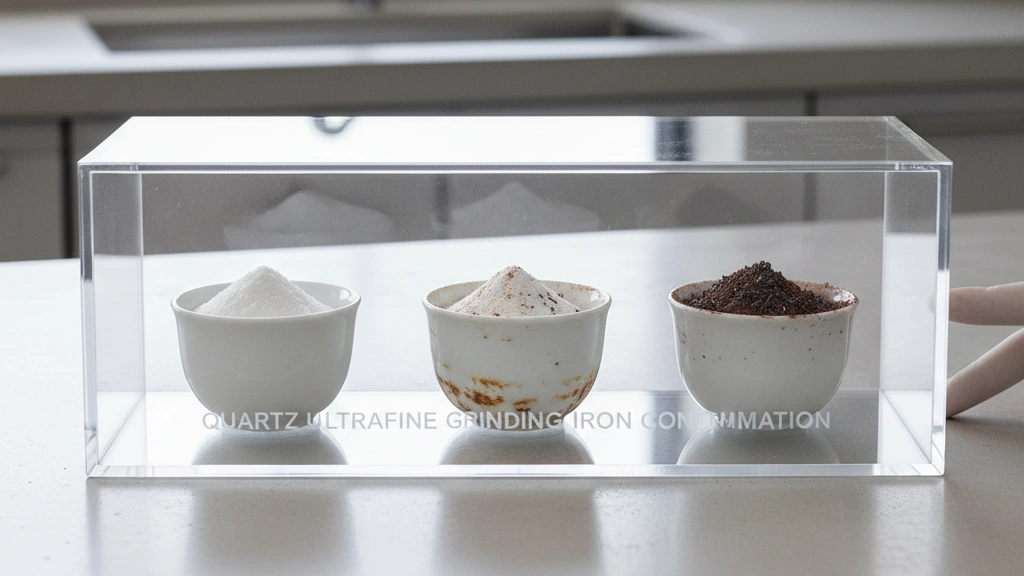
Le dioxyde de silicium (SiO₂) constitue la structure de base du verre, lui conférant une grande résistance mécanique et une excellente stabilité chimique. De ce fait, le sable de quartz est la matière première minérale industrielle la plus importante dans l'industrie verrière. Il entre dans la composition de nombreux produits, du verre plat et du verre d'emballage au verre extra-clair, au verre photovoltaïque et même au verre de quartz.
Pour les fabricants de verre, la qualité du sable de quartz détermine directement la qualité du produit final. L'industrie évalue le sable de quartz principalement selon trois critères essentiels :
– Composition chimique – les niveaux de pureté et d’impuretés, notamment en fer et en alumine.
– Cohérence et stabilité – qualité uniforme d'un lot à l'autre.
– Distribution granulométrique – la taille et la forme des grains appropriées pour une fusion efficace et une homogénéité optimale.
Cependant, tous les verres ne se valent pas, et chaque type de verre exige une qualité de sable de quartz différente. Examinons comment ces exigences se répartissent selon les principales catégories de verre.
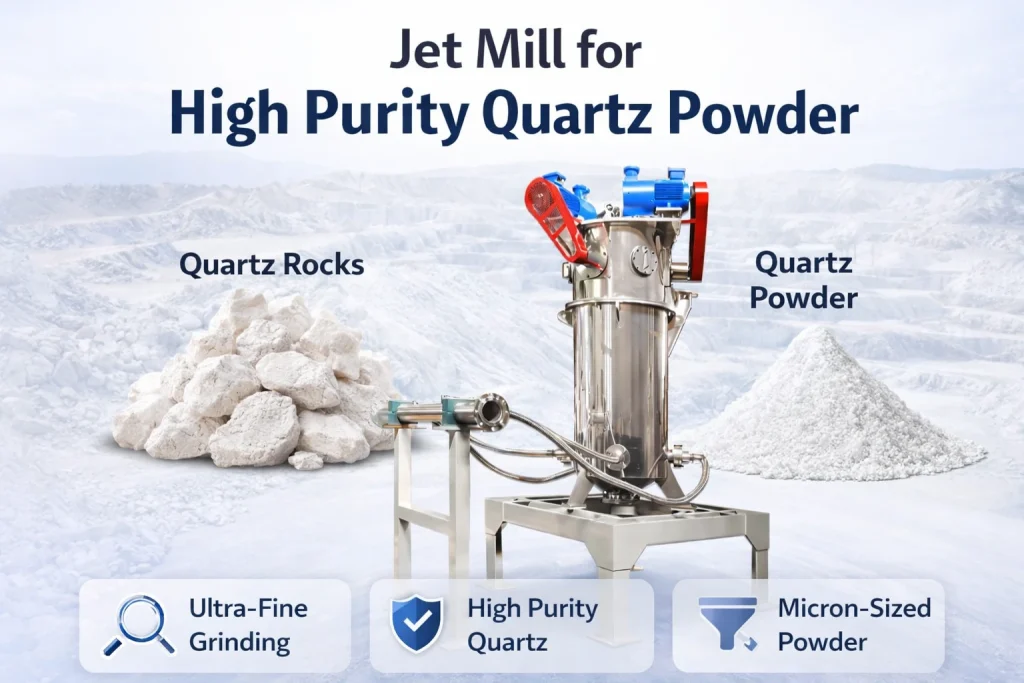
1. Classification du sable de quartz pour l'industrie du verre
La norme industrielle chinoise définit le système de classement et les méthodes d'essai du sable de quartz transformé utilisé dans tous les types de fabrication du verre. Cette norme demeure une référence fondamentale pour les fournisseurs et les producteurs de verre, les aidant à choisir la granulométrie de sable adaptée à l'application prévue.
| Grade | Nom | SiO₂ ≥ (%) | Fe₂O₃ (ppm) | Cr (ppm) | Al (ppm) | Ti (ppm) | Li (ppm) | Na (ppm) | K (ppm) | Perte à l'allumage ≤ (%) |
| 1 | Sable de quartz ultra-pur | 99.98 | 2 | 0.5 | 30 | 2 | 3 | 3 | 3 | 0.1 |
| 2 | Sable de quartz de haute pureté | 99.98 | 4 | 0.5 | 70 | 3 | – | – | – | – |
| 3 | Sable de quartz flottant | 99.95 | 20 | 1.0 | – | 5 | – | – | – | – |
| 4 | Sable de quartz lavé à l'acide | 99.6 | 50 | 2.0 | – | 300 | – | – | – | – |
| 5 | Sable de quartz cristallin | 99.0 | 200 | 2.0 | – | – | – | – | – | – |
| 6 | Verre de laboratoire, sable de quartz | 99.0 | 300 | 2.0 | – | – | – | – | – | – |
| 7 | Sable de quartz ordinaire | 98.5 | 400 | 6.0 | – | – | – | – | – | – |
| 8 | Sable de quartz général | 98.5 | 600 | 6.0 | – | – | – | – | – | – |
| 9 | sable de quartz réfractaire | 97.0 | 2000 | – | – | – | – | – | – | – |
2. Verre plat
Le verre plat trouve de nombreuses applications en aval, et les spécifications du sable de quartz peuvent varier en conséquence. De manière générale, le secteur du verre plat classe le sable de quartz en deux catégories selon sa composition chimique et la granulométrie :
- Type I : Faible teneur en Al₂O₃
- Type II : Teneur en Al₂O₃ plus élevée
La norme professionnelle JC/T 529-2000 « Matières premières siliceuses pour verre plat » définit les exigences détaillées relatives à la composition chimique et à la granulométrie. Les principaux paramètres sont les suivants.
Composition chimique et exigences en matière d'humidité du sable de quartz pour verre plat
| Sable de quartz | w(SiO₂) / % | w(Al₂O₃) / % | w(Fe₂O₃) / % | w(H₂O) / % |
| Classe I | ≤5,00 | |||
| Prime | ≥98,50 | ≤0,50 | ≤0,05 | |
| ≥98,00 | ≤1,20 | |||
| Première année | ≥98,50 | ≤0,70 | ≤0,10 | |
| ≥97,50 | ≤1,20 | |||
| deuxième année | ≥98,00 | ≤0,70 | ≤0,15 | |
| ≥96,50 | ≤1,50 | |||
| troisième année | ≥98,00 | ≤0,70 | ≤0,20 | |
| ≥96,50 | ≤1,50 | |||
| Classe II | ||||
| Première année | ≥92,00 | ≤4,00 | ≤0,20 | |
| deuxième année | ≥90,50 | ≤4,50 | ≤0,30 |
Variation admissible de la composition chimique du sable de quartz pour verre plat
| Sable de quartz | Variation de SiO₂ / % | Variation Al₂O₃ / % | Variation de Fe₂O₃ / % |
| Classe I | |||
| Prime | ±0,20 | ±0,10 | ±0,01 |
| Première année | ±0,30 | ±0,15 | – |
| deuxième année | ±0,30 | ±0,20 | – |
| troisième année | ±0,30 | ±0,20 | – |
| Classe II | |||
| Première année | ±0,30 | ±0,20 | – |
| deuxième année | ±0,30 | ±0,20 | – |
Exigences relatives à la distribution granulométrique du sable de quartz plat
| Sable de quartz | +1 mm | +710 μm | +500 μm | –100 μm (–125 μm) |
| Classe I | ||||
| Prime | ≤0 (0) | ≤0,5 (0,5) | ≤5,0 (5,0) | ≤5,0 (5,0) |
| Première année | ≤0 (0) | ≤0,5 (0,5) | ≤5,0 (5,0) | ≤10,0 (5,0) |
| deuxième année | ≤20,0 (8,0) | |||
| troisième année | ||||
| Classe II | ||||
| Première année | ≤0 (0) | ≤0,5 (0,5) | ≤5,0 (5,0) | ≤5.0 |
| deuxième année | ≤0 (0) | ≤0,5 (0,5) | ≤5,0 (5,0) | ≤5.0 |
Note: Les valeurs entre parenthèses indiquent les exigences relatives aux produits à base de sable de silice naturel.
3. Verre d'emballage et verre domestique
Les produits en verre à usage domestique et d'emballage comprennent les bouteilles et les bocaux, la vaisselle, la verrerie de laboratoire et le verre pharmaceutique. Ils sont utilisés dans les industries agroalimentaire, des boissons, des spiritueux et médicale. Le sable de quartz représente une part importante de la composition des lots de verre dans ce segment.
Le sable de quartz ayant une température de fusion d'environ 1730 °C, la granulométrie des grains influe considérablement sur la formation du verre et l'efficacité de la fusion. En production, on privilégie généralement les particules de quartz anguleuses, car leur grande surface spécifique limite la ségrégation des lots. La granulométrie optimale pour cette application se situe généralement entre 60 et 140 mesh.
Pour la verrerie fine et le verre d'instrumentation, la spécification d'exploration géologique DZ/T 0207-2002 fournit des exigences de qualité pour les matières premières siliceuses.
Exigences de qualité pour le sable de quartz utilisé dans la verrerie de laboratoire
| Élément / Paramètre | Première année | deuxième année | troisième année |
| Composition chimique | |||
| w(SiO₂) / % | >99 | >96 | >90 |
| w(Al₂O₃) / % | <1.0 | <2.0 | <4.0 |
| w(Fe₂O₃) / % | <0,05 | <0,10 | <0,35 |
| w(Cr₂O₃) / % | <0,001 | – | – |
| Remarques | Verrerie (à l'exclusion du verre cristallin) | Verre de laboratoire courant, verre incolore | Utilisé pour les bouteilles en verre ordinaires |
4. Verre ultra-clair
Le verre extra-clair est un matériau haut de gamme reconnu pour son extrême transmittance lumineuse (≥ 91,51 TP3T), sa très faible teneur en fer (généralement de 100 à 150 ppm) et sa clarté cristalline. On l'appelle également verre à faible teneur en fer ou verre à haute transparence.
La production de verre extra-clair exige une combinaison rigoureuse de matières premières, notamment du sable de quartz, du feldspath, de la dolomite, du calcaire, du carbonate de sodium, de l'hydroxyde d'aluminium, du sulfate de sodium, du pyroantimonate de sodium et du trioxyde d'antimoine. Parmi ces composants, le SiO₂ représente environ 71,0 à 73,01 % du volume total, et les impuretés nocives, en particulier le fer, proviennent presque exclusivement du sable de quartz. Par conséquent, la purification du sable de quartz vise principalement à éliminer les impuretés de fer.
Lorsque la teneur en fer dépasse un certain seuil, non seulement la transmission de la lumière chute considérablement, mais les oxydes de fer absorbent également le rayonnement thermique pendant la fusion. Ceci crée un fort gradient de température entre les couches supérieure et inférieure du verre en fusion, ce qui rend la convection difficile et complique fortement la fusion et le raffinage. C'est pourquoi la teneur en fer de la silice brute est le paramètre de conception le plus critique. Les exigences typiques en fer pour le sable de quartz utilisé dans le verre extra-clair sont les suivantes :
– Fe₂O₃ ≤ 150 ppm
– Fe ≤ 80 ppm
Les matériaux de quartz naturel utilisés comprennent le sable de quartz naturel, le grès quartzeux, le quartzite et le quartz veiné.
Valeurs limites de contrôle des oxydes actifs et des impuretés nocives dans les matières premières pour le verre extra-blanc (Unité : wt%)
| Matière première | SiO₂ | Al₂O₃ | Fe₂O₃ | CaO | MgO | Na₂CO₃ | TiO₂ | NaCl |
| sable de quartz | ≥98,5 ±0,3 | ≤1,0 ±0,q | ≤0,01 ±0,001 | ≤0,1 ±0,01 | ||||
| Feldspath | <70 ±0,6 | ≥15 ±0,25 | <0,15 ±0,05 | |||||
| Dolomie | ≥30 ±0,3 | ≥20 ±0,3 | ||||||
| Calcaire | ≤0,018 | ≥52 | ||||||
| espar lourd | ≤0,001 | >99,0 ±0,1 | <0,3 | |||||
| Alumine | ≥63,5 ±0,1 | ≤0,001 | ||||||
| Sel de Glauber (Na₂SO₄) | Fe₂O₃ ≤0,001 | Na₂SO₄ ≥99 ±0,1 | ||||||
| Antimonate de sodium (Na₃SbO₄) | Fe₂O₃ ≤0,055% | Sb₂O₅ ≥64% | ||||||
| Trioxyde d'antimoine (Sb₂O₃) | ||||||||
Remarques : La norme utilisée est la norme nationale Sb₂O₃ de grade 0. Le composant principal de la matière première est ≥ 99,51 TP3T. La taille moyenne des particules est de 1,3 à 1,5 µm, le diamètre moyen de 0,3 à 0,35 µm et la taille maximale des particules est limitée à 5 µm.
5. Verre photovoltaïque (solaire)
Le verre photovoltaïque est installé comme couche extérieure des modules solaires. Son rôle est de protéger les cellules solaires et les électrodes en bloquant l'humidité et les gaz corrosifs, tout en laissant passer un maximum de lumière solaire. Comparé au verre ordinaire, le verre photovoltaïque doit présenter une teneur en fer plus faible, une transmittance lumineuse plus élevée, une meilleure résistance aux chocs et à la corrosion, ainsi qu'une stabilité thermique accrue.
Deux types de verre répondent à ces exigences : le verre flotté extra-clair et le verre imprimé extra-clair (laminé). Le verre imprimé est le choix privilégié pour les cellules solaires en silicium cristallin, tandis que le verre flotté est plus couramment utilisé pour les modules solaires à couches minces.
Les ions ferreux présents dans le sable de quartz peuvent facilement provoquer une décoloration, réduisant ainsi la transmission solaire. Par conséquent, le verre photovoltaïque exige un sable de quartz à haute pureté en silice et à très faible teneur en impuretés, notamment un sable de quartz à faible teneur en fer. La norme industrielle JC/T 2314-2015 « Matières premières siliceuses pour verre photovoltaïque » définit les spécifications de qualité requises.
Exigences de qualité pour les matériaux alumine-silice
| Élément / Paramètre | Première année | deuxième année |
| SiO₂ / % ≥ | 99.5 | 99.0 |
| Al₂O₃ / % ≤ | 0.20 | 0.50 |
| TiO₂ / mg/kg ≤ | 10 | 20 |
| Fe₂O₃ / mg/kg ≤ | 60 | 80 |
| Cr₂O₃ / mg/kg ≤ | 2 | 5 |
| Résidu sur tamis de 1,0 mm / % | 0 | 0 |
| Résidu sur tamis de 0,6 mm / % ≤ | 1.5 | 1.5 |
| Résidu sur tamis de 0,1 mm / % ≤ | 5.0 | 5.0 |
| Absorption d'eau / % ≤ | 5.0 | 5.0 |
6. Verre de quartz
Le verre de quartz est le fleuron des matériaux verriers. Ce verre monocomposant (SiO₂) possède des propriétés mécaniques, thermiques, optiques et électriques exceptionnelles. Il joue un rôle irremplaçable dans les semi-conducteurs, les dispositifs optiques, les communications optiques et les applications liées à l'énergie solaire.
Aujourd'hui, le sable de quartz de haute pureté a remplacé le cristal naturel comme principale matière première pour la fusion du verre de quartz. Qu'il s'agisse de fusion électrique ou de fusion à la flamme, le sable de quartz de haute pureté est le matériau de départ indispensable à la production de tubes, de barres et de lingots de verre de quartz.
Propriétés et caractéristiques
| Non. | Propriété | Caractéristiques / Fonctionnalités |
| ① | Bonne transparence optique | Transmittance extrêmement élevée sur les spectres UV, visible et IR : transmittance UV > 80% ; transmittance dans le visible > 92% |
| ② | Résistance aux hautes températures | Point de ramollissement : 1730 °C ; température d’utilisation à long terme : jusqu’à 1100 °C ; température d’utilisation à court terme : jusqu’à 1450 °C |
| ③ | résistance à la corrosion | Résistant à l'acide fluorhydrique et à l'acide phosphorique chaud ; pratiquement aucune réaction avec les autres acides |
| ④ | Capacité de vide poussé | Le vide peut atteindre 10⁻⁶ Pa |
| ⑤ | Excellente isolation électrique | Résistivité : 1,8 × 10¹⁹ Ω·cm à 20 °C ; 1,6 × 10¹⁶ Ω·cm à 800 °C |
| ⑥ | Faible dilatation thermique | Résiste à des variations de température importantes ; environ 1/20 de la résistance du verre ordinaire |
Absolument ! Voici vos deux tableaux correctement formatés en Markdown, prêts à être copiés directement sur votre site web :
Tableau 5-1 : Exigences relatives aux éléments d’impuretés du sable de quartz pour le verre de quartz
| Application industrielle | Origine | Al (ppm) | Fe (ppm) | Ti (ppm) | Ca (ppm) | B (ppm) | K (ppm) | Na (ppm) | Li (ppm) |
|---|---|---|---|---|---|---|---|---|---|
| Source de lumière électrique | Chine | Total 50–100 ppm | 50–100 | 50–100 | 50–100 | 50–100 | 50–100 | 50–100 | 50–100 |
| Industrie chimique | tchèque | 42 | 3.0 | 3.0 | 8.0 | / | 18.0 | 5.0 | / |
| Semi-conducteur | Chine | 20 | 0.18 | 0.5 | 0.1 | 0.1 | 0.2 | 4.0 | 1.8 |
| Semiconducteur (haute qualité) | USA | 15 | 0.3 | / | 0.4 | 0.1 | 0.7 | 0.9 | 0.7 |
| Semiconducteur (haute qualité) | Russie | 14 | 0.9 | 0.4 | 0.1 | / | 0.3 | 0.6 | / |
| Tube à fibres optiques | Brésil | 11 | 1.8 | 0.4 | 0.1 | / | 0.3 | 0.4 | / |
| Lentille optique | USA | 8 | 0.05 | / | 0.7 | 0.04 | 0.05 | 0.05 | 0.2 |
Note: Les cellules vides indiquent l'absence de limite spécifiée ou des données indisponibles.
Tableau 5-2 : Exigences granulométriques du sable de quartz pour le verre de quartz
| Processus | Four à résistance | Four de fusion continue domestique | Four de fusion continue étranger | Fusion par flamme oxyhydrogène | Plasma |
|---|---|---|---|---|---|
| Taille des particules (maille) | 40–80 | 60–120 | 80–140 | 80–200 | 120–20 |
Choisir le sable de quartz adapté à votre application sur verre
Du verre plat standard aux exigences rigoureuses du verre extra-clair, photovoltaïque et de quartz, la qualité du sable de quartz détermine directement les performances, l'efficacité et le coût du produit. La maîtrise des normes exactes – pureté chimique, teneur en fer et granulométrie – est la première étape vers la production d'un verre de qualité supérieure.
Poudre épique
Poudre épiqueForts de plus de 20 ans d'expérience dans l'industrie des poudres ultrafines, nous contribuons activement à son développement futur, en nous concentrant sur les procédés de concassage, de broyage, de classification et de modification. Contactez-nous pour une consultation gratuite et des solutions sur mesure ! Notre équipe d'experts s'engage à vous fournir des produits et services de haute qualité afin d'optimiser la valeur ajoutée de votre transformation des poudres.

Merci de votre lecture. J'espère que cet article vous sera utile. N'hésitez pas à laisser un commentaire ci-dessous. Vous pouvez également contacter le service client en ligne d'EPIC Powder. Zelda pour toute autre question.
— Jason Wang, Ingénieur
Erreur : Formulaire de contact non trouvé !