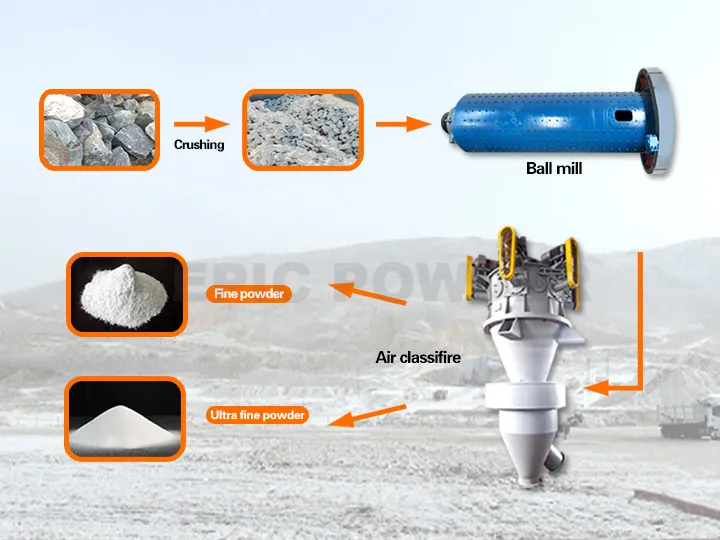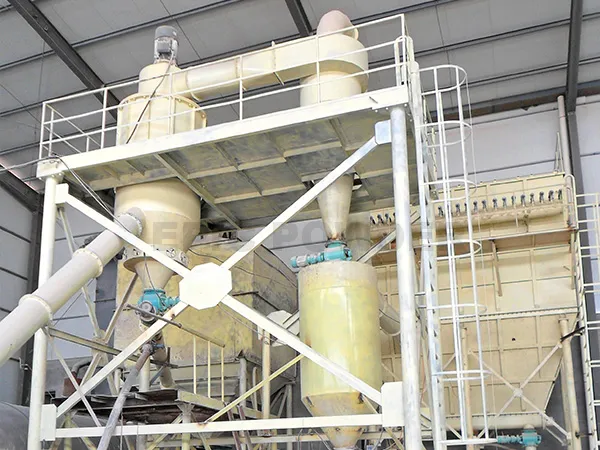
Quartz is one of the most widely processed industrial minerals, but ‘quartz powder’ covers an enormous range of specifications. The D97 for glass sand is 150-300 microns. For electronics-grade fused silica filler, it is 5-15 microns. For the finest silica powder used in semiconductor packaging, it is below 5 microns. These are not variations of the same process — they require completely different equipment, different energy budgets, and different quality controls.
The most common mistake in quartz processing line design is selecting equipment based on throughput alone, without mapping the target fineness and purity to the right grinding and classification technology. A ball mill that handles 5 t/h at D97 40 microns cannot economically produce D97 10 microns. A jet mill that produces D97 5 microns at high purity runs at a fraction of the throughput and at 3-5 times the specific energy cost. Getting the technology match right from the start determines whether a quartz processing line is profitable.
This guide maps quartz applications to their fineness requirements, explains which grinding technology covers which part of the range and why, and gives real production data from operating lines.
Quartz Applications and the Fineness Each Market Requires
Quartz is hard (Mohs 7), abrasive, and relatively brittle. It grinds well across a wide size range, but the fineness required varies dramatically by application — and so does the acceptable impurity level.
| Application | Typical D97 | SiO2 Purity Min. | Key Quality Driver |
| Glass sand (standard) | 150-300 um | >99.5% | Fe2O3 < 0.03%; particle shape affects melt behaviour |
| Engineered stone / countertop | < 45 um (fine fraction) | 99%+ | Tight PSD for packing density; reduces resin consumption |
| Coatings and plastics filler | D97 10-45 um | 98-99% | Narrow PSD for dispersibility; whiteness matters |
| Refractories and foundry | 150 um – 2 mm | 97%+ | Particle shape and thermal stability; low fines fraction |
| Electronics / EMC filler | D97 5-25 um | 99.9%+ | Fe < 30 ppm; tight D97 and Dmax for killer particle control |
| Semiconductor packaging (WLP) | D97 < 8 um | 99.97% | U + Th < 0.5 ppb; amorphous content > 99.5% |
Specifications vary by customer and region. Confirm against your buyer’s incoming inspection requirements before setting production parameters.
The purity requirements at the bottom of the table — electronics and semiconductor grades — are not achievable by grinding and classification alone. They require upstream beneficiation (magnetic separation, acid leaching, or flotation) to reduce Fe2O3 and other impurities to the required level before the grinding step. For the applications in the upper rows of the table, standard grinding and air classification without beneficiation is typically sufficient.
Three Technologies and the Range Each Covers
Ball Mill with Air Classifier — The Production Workhorse
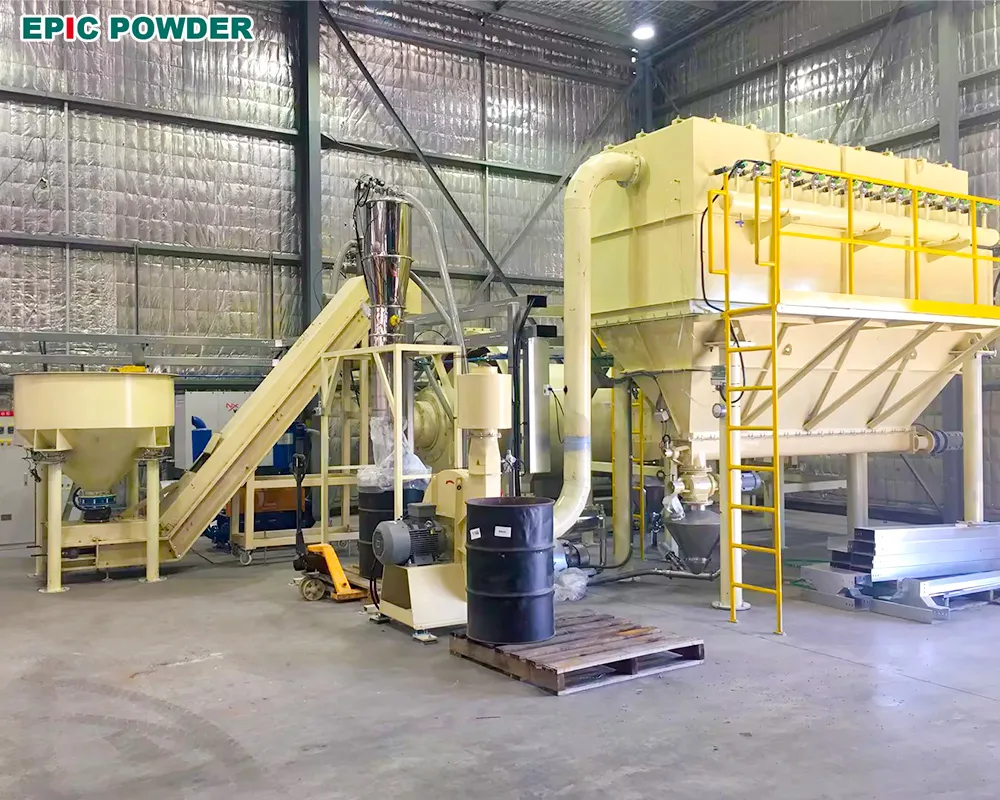
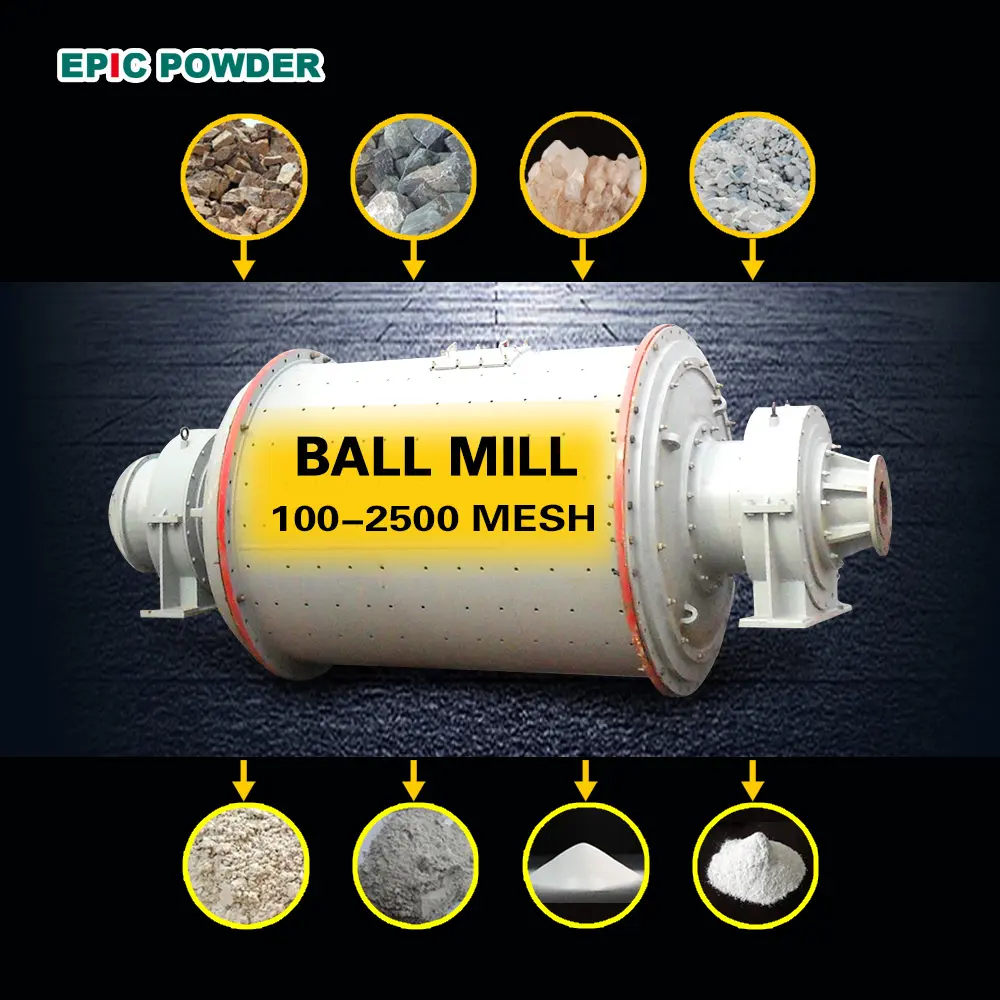
A ceramic-lined ball mill in closed circuit with a dynamic air classifier is the most energy-efficient route for quartz powder at D97 20-75 microns. The ball mill provides the continuous size reduction; the air classifier sorts the output, returning oversize to the mill and sending on-spec product to collection. Feed size is typically below 3-5 mm from a jaw crusher; product size is controlled by classifier wheel speed.
This configuration handles the bulk of commercial quartz powder production: general fillers, coatings grade, engineered stone fine fraction, and standard glass cullet powder. At D97 37-45 microns (the most common filler specification), a medium-scale ball mill and classifier line produces 3-8 t/h with specific energy consumption of 30-45 kWh per tonne. For comparison, producing the same D97 with a jet mill would cost 90-120 kWh per tonne — three to four times higher — without any quality benefit at this fineness.
Liner material selection matters for quartz because of its hardness (Mohs 7). Alumina ceramic liners and grinding media are standard for quartz processing: they last substantially longer than steel against this abrasive material and avoid iron contamination in the product. For electronics-grade applications where even trace Al contamination is specified, zirconia liners and media eliminate the Al pathway at higher equipment cost.
Jet Mill — For Fine and High-Purity Grades
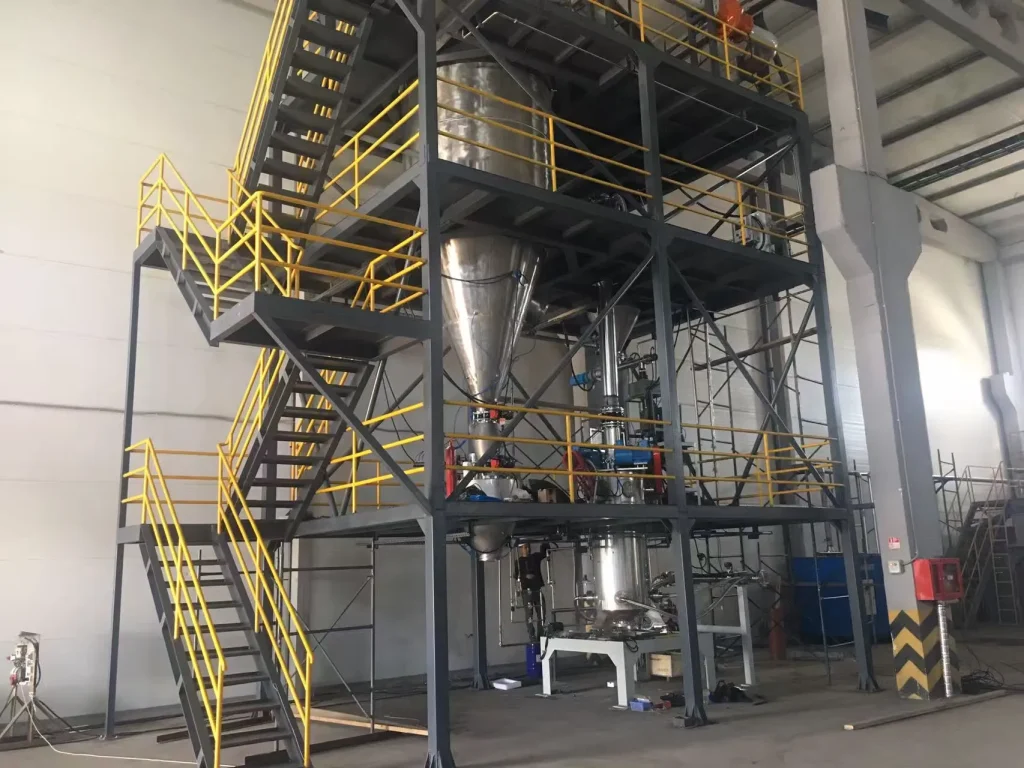
A fluidised bed jet mill uses compressed gas jets to accelerate quartz particles into supersonic collision with each other. There are no grinding media, no metal surfaces in the grinding zone. The integrated dynamic classifier controls the product D97. This configuration is the right choice for two scenarios: very fine product (D97 below 15 microns) and high-purity product (electronics-grade silica where metal contamination from grinding media is unacceptable).
For D97 5-15 microns, a jet mill consistently achieves narrower PSD than a ball mill at equivalent median size — the tight D97 control from the integrated classifier is more precise than can be achieved with a ball mill plus separate classifier at fine sizes. The energy cost is substantially higher (80-150 kWh per tonne vs. 30-60 kWh per tonne for a ball mill), which is justified only when the product value supports it. Electronics-grade fused silica at $40-80/kg makes the jet mill energy premium trivial relative to product revenue. Standard coatings filler at $150-400/tonne does not.
Standalone Air Classifier — Upgrading Existing Product
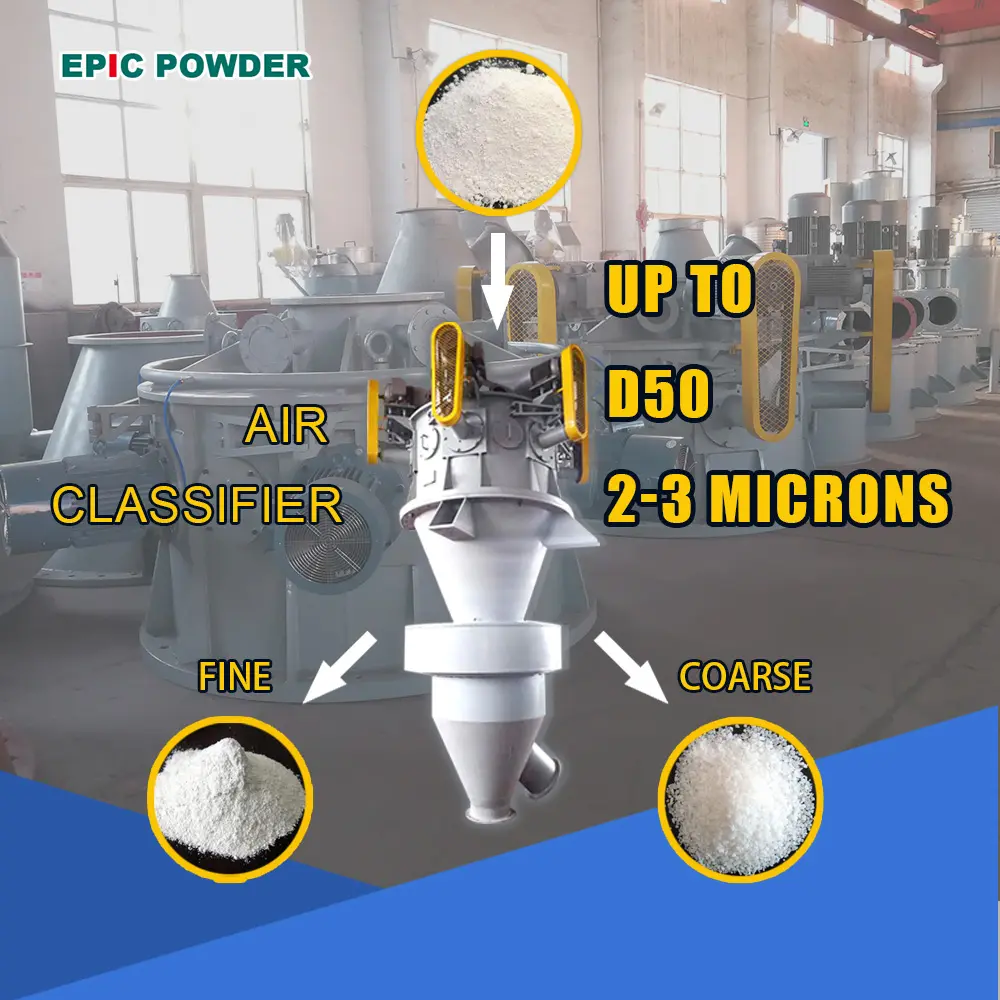
When a producer already has a mill or crusher and needs to sharpen the PSD of their output — removing oversize particles to bring the product D97 within specification — a standalone air classifier adds classification without requiring a new mill. The classifier cuts at the target D97; oversize returns to the existing mill; on-spec product exits to collection. This is the most common upgrade path for existing quartz operations that are producing a slightly coarser product than their market requires.
A standalone classifier is also useful for producing two product grades from a single mill: a primary cut at D97 45 microns for a standard filler market, and a secondary fines fraction at D97 15-20 microns for a higher-value application. The economics depend on whether the higher-value fine fraction is large enough in volume to justify the classifier investment.
| Factor | Ball Mill + Classifier | Jet Mill | Standalone Classifier |
| Practical D97 range | 20-75 um | 3-20 um | Depends on upstream mill |
| Specific energy (kWh/t) | 30-60 (at D97 30-45 um) | 80-150 (at D97 5-15 um) | Low — classification only |
| Metal contamination risk | Low (ceramic lined) | Near zero (no media) | Depends on upstream |
| Capital cost (relative) | Medium | High | Low-medium |
| Best application | Filler, coatings, stone (D97 20-75 um) | Electronics, fine silica (D97 < 15 um) | Upgrading existing line PSD |
| Throughput scalability | High (1-20+ t/h) | Medium (0.5-5 t/h) | Matches upstream mill |
Real Production Results
CASE STUDY 1
Quartz Filler Production Line — 5 t/h at D97 37.7 μm in Anhui, China
Project overview
A mineral processing factory in Anhui Province needed a complete quartz powder production line for the coatings and plastics filler market. After evaluating several equipment suppliers, they selected EPIC Powder Machinery for a dual-line ball mill and air classifier configuration.
- Raw material: quartz ore, SiO2 above 98.5%
- Feed size: below 3 mm after jaw and impact crushing
- System: two parallel ball mill and air classifier production lines
- Design capacity: 5 t/h per line (10 t/h total)
- Target product: D97 approximately 37.7 microns for coatings filler market
Outcome
Both lines reached stable operation within one week of commissioning. Product D97 measured consistently at 37-38 microns across multiple production shifts. PSD span was within the coatings customer’s incoming specification. The client confirmed the throughput and classification efficiency met their production targets without requiring any parameter adjustment after commissioning.
CASE STUDY 2
Silica Powder Line Upgrade — Standalone Classifier Tightens D97 for Polymer Filler Market
The situation
A silica processor supplying the rubber and polymer filler market was producing a product with D97 in the 55-65 micron range — wider than the 45-micron maximum their customers required. Their existing ball mill was sized correctly for throughput but the downstream classification was a fixed-screen separator that could not reliably achieve the D97 target. The options were: replace the ball mill (expensive, long downtime), add a second mill stage (complex), or install a standalone air classifier between the existing mill and the collection system.
The solution
EPIC Powder Machinery supplied a standalone dynamic air classifier sized to match the existing mill’s output rate. The classifier was configured with a D97 cut point of 42 microns. Oversize product (approximately 15-20% of the mill output) returned to the mill feed via a pneumatic return line. Fine on-spec product was collected in the existing bag filter.
Results
Product D97: reduced from 55-65 microns to consistently 40-43 microns — within the customer’s 45-micron limit
Throughput: net output reduced by approximately 12% due to the oversize return stream — accepted as a necessary trade-off for specification compliance
Customer qualification: product passed incoming inspection at the polymer filler customer on the first batch after the classifier installation
Installation: completed in 3 days without stopping the ball mill — the classifier was installed on the existing conveying system during a scheduled maintenance window
| Designing a Quartz Grinding Line? Talk to EPIC Powder Machinery First. Whether you are processing quartz for glass, electronics-grade silica, coatings fillers, or engineered stone, EPIC Powder Machinery can size and configure the right combination of ball mill, jet mill, and air classifier for your feed material and product specification. We offer free process consultations and material trials before any equipment commitment.Tell us your raw material, target fineness, and production volume and we will recommend a specific line configuration with throughput and energy consumption projections. Request a Free Process Consultation: https://www.quartz-grinding.com/contact-us/ Explore Our Quartz Grinding Solutions: www.quartz-grinding.com |
Frequently Asked Questions
How do I choose between a ball mill and a jet mill for quartz grinding?
The decision comes down to your target fineness and product value. Ball mills with air classifiers are the right choice for D97 20-75 microns — the range that covers standard fillers, coatings grade, and engineered stone fine powder. At this fineness, specific energy consumption is 30-60 kWh per tonne and throughput scales easily to 5-20 t/h. Jet mills are the right choice when you need D97 below 15 microns, or when your application requires near-zero metal contamination regardless of particle size (electronics-grade silica, semiconductor packaging filler). At D97 5-15 microns, jet mills provide better PSD sharpness and cleaner product than a ball mill can achieve at this fineness. The energy cost is 3-5 times higher per tonne, which is economically justified for high-value silica products but not for standard industrial fillers.
What role does the air classifier play in a quartz grinding line — can I run a ball mill without one?
You can run a ball mill without an air classifier, but the product will have a broad PSD with a significant oversize fraction that most filler and coatings applications will not accept. An open-circuit ball mill (no classifier) produces a wide distribution — D10 might be 2 microns while D97 is 80 microns for the same batch, depending on your mill settings. Adding a dynamic air classifier closes the circuit: oversize returns to the mill and only on-spec product exits the system.
This narrows the PSD substantially, eliminates oversize particles that would fail customer incoming inspection, and improves energy efficiency because material is removed from the circuit as soon as it reaches specification rather than being over-ground. For any quartz product above 325 mesh, a closed-circuit ball mill with air classifier is the standard configuration — open circuit is only appropriate for very coarse products like glass sand where PSD requirements are loose.
What causes quartz grinding mills to wear out quickly, and how do you extend wear life?
Mohs hardness of 7 means quartz abrades steel and most engineering materials rapidly. In a ball mill, the three wear items are the grinding balls, the mill liner, and the classifier wheel. For quartz, alumina ceramic balls and liners dramatically outlast steel: ceramic has Mohs hardness 9-9.5, harder than quartz, so the wear rate is much lower. The trade-off is cost — ceramic balls and liners are more expensive than steel — but for quartz, the total cost over the service life is lower because replacement frequency drops substantially.
In a jet mill, the wear items are the nozzle inserts and the classifier wheel. Tungsten carbide or ceramic nozzle inserts are standard for quartz processing. In an air classifier, the classifier wheel is the primary wear item — for quartz, ceramic-coated or full-ceramic wheels are preferred. Monitoring wear by tracking product D97 over time is the practical indicator: gradual D97 drift upward is the first sign that classifier wear is affecting cut point performance.
Epic Powder
Epic Powder, 20+ years of experience in the ultrafine powder industry. Actively promote the future development of ultra-fine powder, focusing on crushing, grinding, classifying and modification process of ultra-fine powder. Contact us for a free consultation and customized solutions! Our expert team is dedicated to providing high-quality products and services to maximize the value of your powder processing. Epic Powder—Your Trusted Powder Processing Expert!

“Thanks for reading. I hope my article helps. Please leave a comment down below. You may also contact EPIC Powder online customer representative Zelda for any further inquiries.”
— Jason Wang, Engineer