Quartz powder is a mineral filler made by grinding quartz rock into fine particles. Paint and coating formulators add it to improve hardness, abrasion resistance, weather resistance, and chemical inertness. It carries a Mohs hardness of 7, the highest among common paint fillers.
Paint grade quartz powder requires SiO₂ purity between 98.5% and 99.5% for chemical inertness and durable film. Low Fe₂O₃ content keeps whiteness and color purity high. Typical mesh grading runs from 44 μm to 74 μm or finer for a smooth film without grittiness.

Hardness and Abrasion Resistance
Quartz powder transfers its hardness to the cured film. Industrial topcoats and floor coatings use micronized quartz to resist scratching and wear. Suppliers specify SiO₂ at 99% or more and 74–25 μm for these applications.
This hardness comes from the mineral itself. Quartz is the crystalline form of silica, with a Mohs hardness of 7. Calcite and other common fillers sit lower on the scale, so quartz delivers more mechanical durability per loading level.
Weather and UV Resistance
Exterior coatings expose fillers to sunlight, rain, and temperature swings. Quartz powder resists breakdown under these conditions because it is chemically stable and inert. Ultra-fine grades at 20 μm produce a smooth, uniform film with strong UV and weathering durability for architectural exterior coatings.
This resistance to fading and surface degradation explains why paint makers select quartz for exterior architectural and industrial finishes that must survive years outdoors.
Functions Inside the Coating
Quartz powder works as a functional filler and extender, not simply a cheap diluent. Its high hardness, good suspension, low oil absorption, and strong weatherability improve wear, corrosion, high-temperature, and insulation resistance in the coating.
Low oil absorption matters in formulation. A filler that soaks less binder leaves more resin free to form a continuous film. Quartz powder, with its low oil absorption, supports better film integrity without forcing a large binder increase.
Purity and Iron Content
Purity controls both performance and appearance. Paint grade quartz needs SiO₂ purity of 98.5–99.5%. Iron oxide (Fe₂O₃) must stay low because even small amounts tint the powder and dull the finish. Higher purity grades, above 99.5%, suit premium and specialty coatings.
Particle Size and Grading
Particle size determines film smoothness and gloss. Coarse quartz powder leaves visible grit in thin films. Fine grades at 44-74 μm or finer produce a smooth surface. Ultra-fine grades run 5-37 μm for small loadings and better optical performance.
Whiteness also follows grading. Finer quartz grades with clean processing reach whiteness values from 70 to 94, which keeps tinted and white coatings bright.
Common Specification for Paint Grade Quartz Powder
· SiO₂ purity: 98.5–99.5% (paint grade), 99%+ (premium/industrial)
· Fineness: 44–74 μm typical, 5–37 μm for fine grades, 20 μm for ultra-fine exterior
· Whiteness: 70–94
· Low Fe₂O₃ for color purity
· Mohs hardness: 7
Grinding Equipment for Quartz Powder
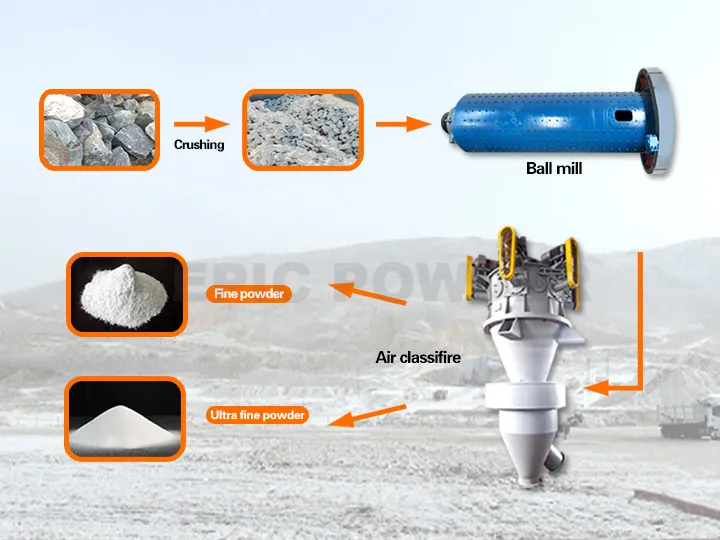
Producing paint grade quartz powder requires controlled grinding and classification. Quartz is hard and abrasive, so the mill and classifier must use wear-resistant construction. The process must also hold particle size within tight limits to avoid gritty films.
Epic Toz Makinaları builds quartz grinding production lines for coatings and paints. Roller mills and Raymond mills reduce quartz rock in high volumes.
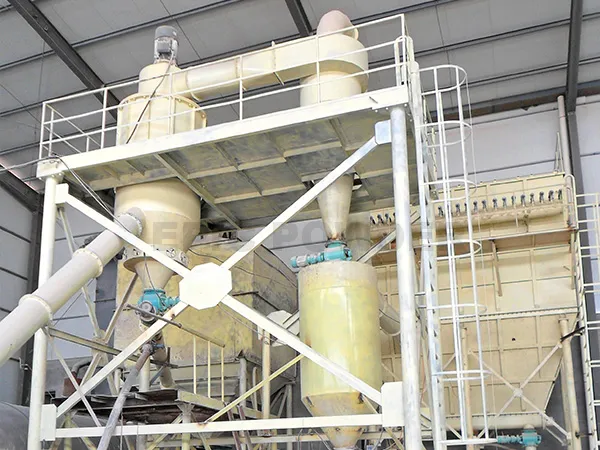
Air classifiers pair with these mills to separate oversized particles and return them for regrinding. This closed-loop setup keeps the top size within specification and smooths batch-to-batch variation. For paint grades, the line typically adds magnetic separation to minimize iron contamination and protect whiteness.
Epic Powder supplies two classifier series matched to quartz fineness. The HTS classifier separates products at D97 5–20 μm, the ultra-fine grades. The ITC series classifier separates products at D97 8–75 μm, covering fine and medium grades. The choice between them follows the target top size of the paint or coating filler.
The mill selection depends on target fineness, throughput, and the purity the end coating requires. Coarse grades demand less energy. Ultra-fine grades need multi-stage grinding and precise classification.
Epik Toz
Epik Toz designs grinding and classifying systems for minerals, chemicals, food, and pharmaceuticals. With more than 20 years of powder processing experience, we match the right mill to your target particle size and capacity. Tell us about your material and we will recommend a tested solution.

"Okuduğunuz için teşekkürler. Umarım makalem yardımcı olur. Lütfen aşağıya yorum bırakın. Ayrıca EPIC Powder online müşteri temsilcisiyle iletişime geçebilirsiniz. Zelda Daha fazla bilgi için.”
— Jason Wang, Mühendis