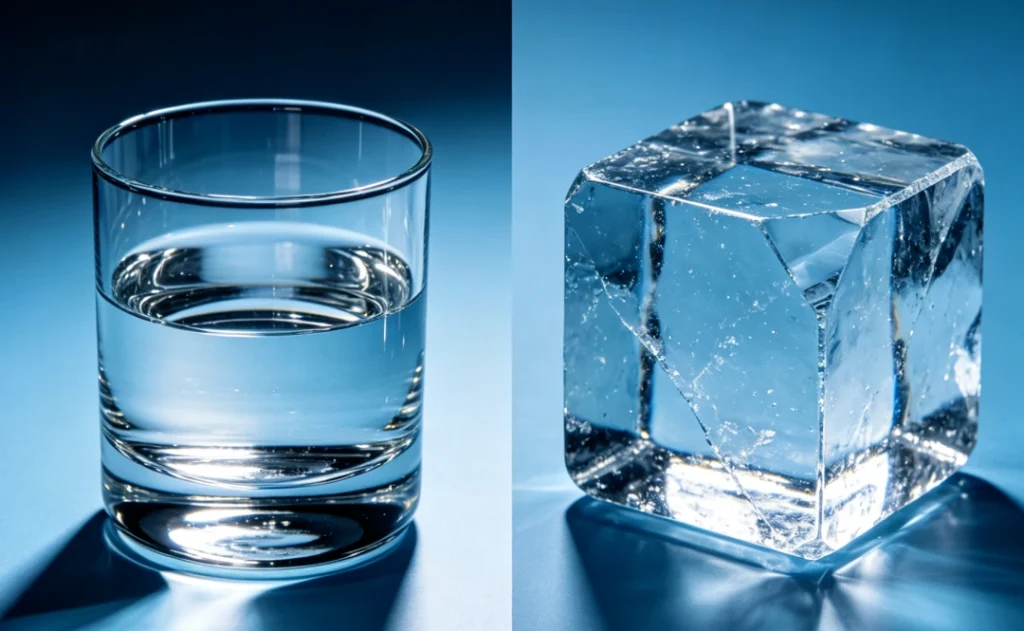
Si trabajas con vidrio especial, semiconductores, componentes ópticos o equipos industriales de alta temperatura, es probable que te hayas encontrado con esta pregunta: ¿Por qué el vidrio de cuarzo es mucho más caro que el vidrio común si ambos parecen transparentes y similares?
La respuesta no reside en la apariencia, sino en las propiedades del material. El comportamiento térmico, la transmisión espectral, la expansión térmica y la pureza son todos muy importantes. Para los compradores de equipos de procesamiento de polvo, comprender estas diferencias también es fundamental, porque la calidad de polvo de cuarzo de alta pureza Determina directamente el rendimiento del producto final de vidrio de cuarzo.
Analicemos las principales diferencias desde una perspectiva de ingeniería y, a continuación, veamos cómo el equipo de molienda y clasificación adecuado le ayuda a lograr la pureza y la uniformidad del tamaño de partícula que exigen las aplicaciones de alta gama.
1. Resistencia térmica y choque térmico
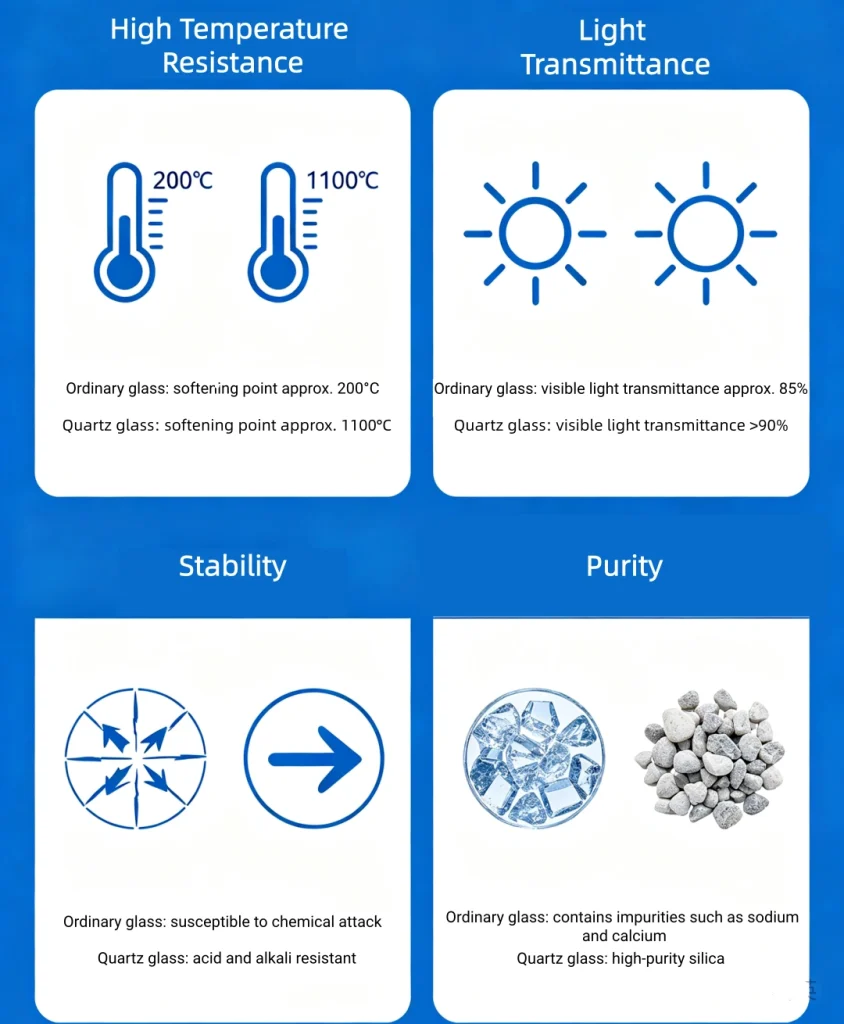
El vidrio común de sílice-soda tiene una temperatura máxima de servicio de alrededor de 600 °C, pero su principal debilidad radica en su escasa resistencia al choque térmico. Un cambio brusco de temperatura —por ejemplo, verter agua hirviendo sobre un vidrio grueso— genera tensiones internas que suelen provocar una fractura inmediata.
El vidrio de cuarzo (sílice fundida) se comporta de manera muy diferente. Puede funcionar de forma continua a 1100 °C y soportar breves fluctuaciones a temperaturas aún más elevadas. Su bajo coeficiente de dilatación térmica (aproximadamente 5,5 × 10⁻⁷ / K, cerca de 1/20 del del vidrio común) le permite soportar cambios bruscos de temperatura, como el paso directo de una llama a agua fría. Por ello, el vidrio de cuarzo es la única opción para ventanas de hornos de alta temperatura, carcasas de lámparas de desinfección UV y material de laboratorio sometido a ciclos repetidos de calentamiento y enfriamiento.
2. Transmisión óptica: rendimiento en el rango UV y de longitud de onda corta.
A simple vista, ambos tipos de vidrio parecen transparentes. Sin embargo, al medir la transmitancia en el rango ultravioleta y ultravioleta profundo, la diferencia es notable. El vidrio común bloquea la mayoría de las longitudes de onda UV-B y UV-C debido a impurezas de hierro y otros aditivos. Por eso, el vidrio estándar para ventanas no se oscurece con la luz solar: simplemente no transmite la radiación UV que lo activa.
El vidrio de cuarzo, especialmente cuando se fabrica con materias primas de alta pureza, transmite luz desde el ultravioleta profundo (hasta aproximadamente 160 nm) a través del espectro visible e infrarrojo. Esta amplia transmisión espectral es esencial para aplicaciones como el curado UV, la óptica láser, la litografía de semiconductores y los dispositivos de estética médica. Si se utilizara vidrio común en estos sistemas, la luz sería absorbida, lo que inutilizaría el equipo.
3. Coeficiente de expansión térmica (CTE)
El coeficiente de dilatación térmica (CTE) del vidrio común es de aproximadamente 9 × 10⁻⁶ / K. Si bien es manejable para un calentamiento uniforme, se vuelve problemático en aplicaciones con gradientes de temperatura o cargas térmicas cíclicas. La expansión desigual genera tensiones y, con el tiempo o ante cambios bruscos, el material se agrieta.
El vidrio de cuarzo tiene un coeficiente de dilatación térmica (CTE) excepcionalmente bajo, de aproximadamente 0,55 × 10⁻⁶/K desde la temperatura ambiente hasta los 1000 °C. Esto significa que apenas se expande al calentarse y no se contrae de forma apreciable al enfriarse. El resultado práctico: los componentes fabricados con vidrio de cuarzo mantienen la estabilidad dimensional, resisten la fatiga térmica y pueden utilizarse en aplicaciones donde el vidrio común se rompería en cuestión de minutos, como lámparas industriales de alta potencia, mirillas para hornos de funcionamiento continuo y bancos ópticos de precisión.
4. Control de pureza e impurezas
Las materias primas para el vidrio común incluyen arena de sílice, carbonato de sodio y piedra caliza, que contienen niveles significativos de hierro, aluminio, calcio y otros elementos. Estas impurezas son aceptables para ventanas y botellas, pero resultan perjudiciales en aplicaciones electrónicas, ópticas y de alta temperatura.
El vidrio de cuarzo se produce a partir de cuarzo de alta pureza (a menudo con una pureza del 99,9951% o superior). La materia prima se somete a procesos de beneficio, fusión y conformado de precisión. Un bajo nivel de impurezas se traduce en menos inclusiones de burbujas, mejor transmisión UV, mayor resistencia química y propiedades dieléctricas uniformes. Esta pureza es la que cualifica al vidrio de cuarzo para su uso en semiconductores, fibra óptica, cavidades láser e instrumentos de investigación de precisión. En resumen, el vidrio común es un producto básico; el vidrio de cuarzo es un material de ingeniería.
5. ¿Por qué la diferencia de precio es tan grande?
La diferencia de costos suele ser de 10 a 50 veces. Esto se debe a varios factores:
- La materia prima de cuarzo de alta pureza es significativamente más cara que la arena de sílice común.
- La fusión del vidrio de cuarzo requiere temperaturas superiores a 2000 °C, con un alto consumo de energía.
- Los índices de rendimiento son más bajos; los defectos, las burbujas o las inclusiones obligan al rechazo del producto.
- El postprocesamiento (corte, desbaste, pulido) es más exigente debido a la dureza del material.
- Los mercados finales (semiconductores, industria aeroespacial, óptica de precisión) exigen tolerancias estrictas y una calidad trazable.
Para los fabricantes en la cadena de suministro de cuarzo, desde el procesamiento del mineral de cuarzo hasta la producción de vidrio especial, controlar la pureza y el tamaño de las partículas en el etapa de polvo es un factor determinante de la calidad y el coste del producto final.
El paso crítico: Procesamiento de polvo de cuarzo de alta pureza
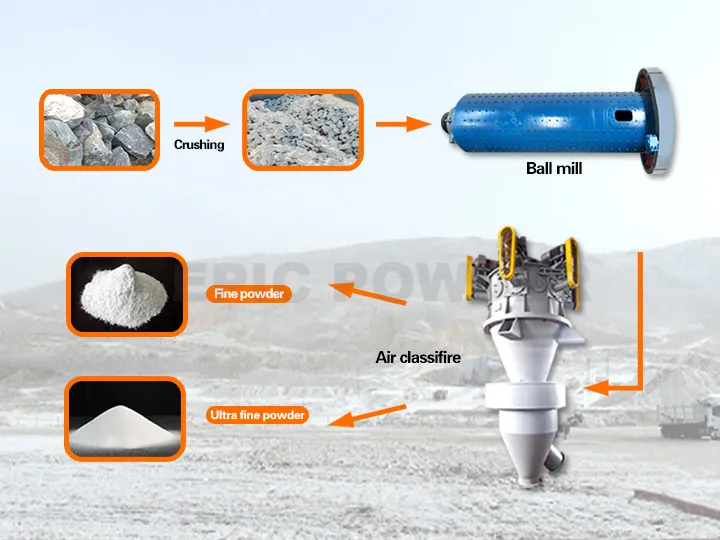
Antes de poder fabricar vidrio de cuarzo, el cuarzo en bruto debe triturarse, molerse y clasificarse hasta obtener un polvo uniforme de alta pureza. Para muchos compradores técnicos, el desafío consiste en encontrar equipos de molienda que:
- Minimiza la contaminación (especialmente por hierro y otros metales de transición).
- Produce una distribución estrecha del tamaño de partícula (por ejemplo, d97 = 3–45 µm para productos molidos por chorro).
- Maneja cuarzo abrasivo con bajo desgaste.
- Escala desde el laboratorio hasta la producción industrial.
Ahí es donde Polvo ÉPICO Proporciona una solución práctica.
Soluciones de equipamiento de EPIC Powder
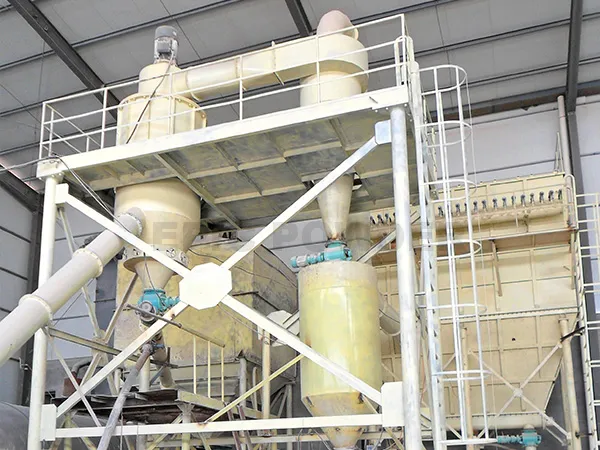
EPIC Powder diseña y fabrica sistemas completos para el procesamiento de cuarzo y sílice de alta pureza. Nuestros equipos son utilizados por fabricantes de vidrio de cuarzo, productores de rellenos electrónicos y procesadores de minerales especiales en todo el mundo.
- Molinos de chorro Ideal para polvo de cuarzo ultrafino de hasta d97 = 3 µm. La ausencia de medios de molienda prácticamente elimina la contaminación por metales. El clasificador de aire integrado garantiza una distribución granulométrica precisa, fundamental para un comportamiento de fusión y unas propiedades ópticas uniformes en el vidrio de cuarzo.

- Molinos de bolas con clasificadores de aire – Para la producción continua de polvo de cuarzo de 200 a 3000 mallas. Esta configuración ofrece un alto rendimiento y la flexibilidad de ajustar la finura en línea. Utilizamos revestimientos cerámicos y medios de alúmina para mantener la absorción de hierro por debajo de 20 ppm.
- Clasificadores de aire (autónomos) Cuando necesite separar polvo fino de fracciones gruesas o eliminar partículas de gran tamaño, nuestros clasificadores de vórtice forzado logran puntos de corte de 5 µm a 150 µm con una gran precisión.
- Sistemas de modificación de superficies – Para polvos de cuarzo de ingeniería que requieren agentes de acoplamiento o recubrimientos funcionales, nuestras líneas de recubrimiento continuo mejoran la dispersibilidad y la compatibilidad con polímeros o resinas.
¿Por qué los compradores técnicos eligen EPIC Powder?
- Diseño de baja contaminación: Nuestros molinos y clasificadores pueden configurarse con recubrimientos cerámicos, de poliuretano o resistentes al desgaste para preservar la pureza del producto.
- Control preciso del tamaño de partícula: Desde fresadoras de chorro de laboratorio hasta líneas de producción a escala industrial, ofrecemos resultados repetibles que cumplen con las especificaciones de grado semiconductor.
- Integración de procesos: Suministramos líneas completas —trituración, molienda, clasificación, recogida de polvo y transporte— con automatización PLC.
- Soporte global: Con más de dos décadas de experiencia en ingeniería de polvos, ofrecemos validación de procesos, puesta en marcha in situ y resolución de problemas de forma remota.
Si su empresa se dedica al procesamiento de cuarzo de alta pureza, a la producción de sílice esférica o a la preparación de materia prima para vidrio de cuarzo, le invitamos a que hable sobre su aplicación con nuestro equipo de ingeniería.
➡️ Contacte con EPIC Powder para una consulta sobre el proceso.
➡️ Descubra nuestras soluciones de fresado de cuarzo.
Resumen para quienes toman decisiones
- Vidrio común Es adecuado para ventanas, contenedores y construcciones en general donde no se requieren altas temperaturas, transmisión de rayos UV o estabilidad térmica extrema.
- vidrio de cuarzo Es esencial para semiconductores, óptica UV, sistemas láser, componentes industriales de alta temperatura y aparatos de laboratorio de precisión, y su rendimiento comienza con la calidad del polvo de cuarzo.
Para los compradores técnicos y los ingenieros de procesamiento de polvos, el equipo adecuado de molienda y clasificación no es solo un centro de costos; es un factor determinante de la pureza, el rendimiento y el valor de mercado del producto. EPIC Powder le proporciona la ingeniería y el equipo necesarios para satisfacer estas exigencias de forma fiable.
Polvo épico

Gracias por leer. Espero que mi artículo te haya sido útil. Deja un comentario abajo. También puedes contactar con el servicio de atención al cliente de EPIC Powder en línea. Zelda para cualquier otra consulta.
— Emily Chen, Ingeniero