Oilfield cementing and completion fluids buy silica flour from 100 to 325 mesh. Buyers judge a lot on the measured particle size distribution. That distribution comes from the grinding circuit and the classifier.
Two plants working the same deposit can ship very different powders. One holds D97 at 45 µm on every lot. The other drifts, and the drift shows up as residue on the buyer’s control sieve. Suppliers also list this product as fine 실리카 파우더 or quartz powder. Oilfield specifications use the name silica flour.
Three Products the Oilfield Buys Below 100 Mesh
| Product | Size | Where it goes | Spec that decides the sale |
|---|---|---|---|
| 100 mesh sand | 150 µm and below, narrow band | Frac stages in tight rock, tail-in stages | Residue on 140 mesh, crush fines |
| Silica flour, 200 mesh | D97 near 75 µm | Cement blends, drill-in and completion fluids | Residue on 200 mesh, D50 |
| Silica flour, 325 mesh | D97 near 45 µm | High-temperature cementing, specialty slurries | Residue on 325 mesh, D97 stability lot to lot |
The 325 mesh grade carries the highest price and the tightest spec. Buyers check the top cut before they look at anything else.
Why Cementing Needs the Fine Cut
Above roughly 110 °C, set cement loses strength over time. Fine silica reacts with the lime released during hydration and keeps the matrix stable at temperature.
That reaction runs on surface area. Coarse grains react slowly and leave unreacted material sitting in the set cement. A 100 mesh product cannot do the work of a 325 mesh product in a hot well.
Particle size also sets slurry behavior. Oversize grains settle in the mixing tank and drop out of suspension. A tight top cut keeps the blend uniform from the plant to the wellhead.
Mesh, Microns, and What Each Cut Is For
| Sieve | Opening | Typical oilfield use |
|---|---|---|
| 100 mesh | 150 µm | Fine frac sand, tail-in stages |
| 140 mesh | 106 µm | Control sieve for 100 mesh products |
| 200 mesh | 75 µm | Cement blends, general silica flour |
| 270 mesh | 53 µm | Finer cement blends |
| 325 mesh | 45 µm | High-temperature wells, tightest residue limit |
Sieve numbers are nominal. Two suppliers can both label a bag 325 mesh and still ship powders with different D97 and different residue.
Buyers who have seen a lot drift ask for the measured curve before they place the next order.
Three Circuits, Three Cost Structures
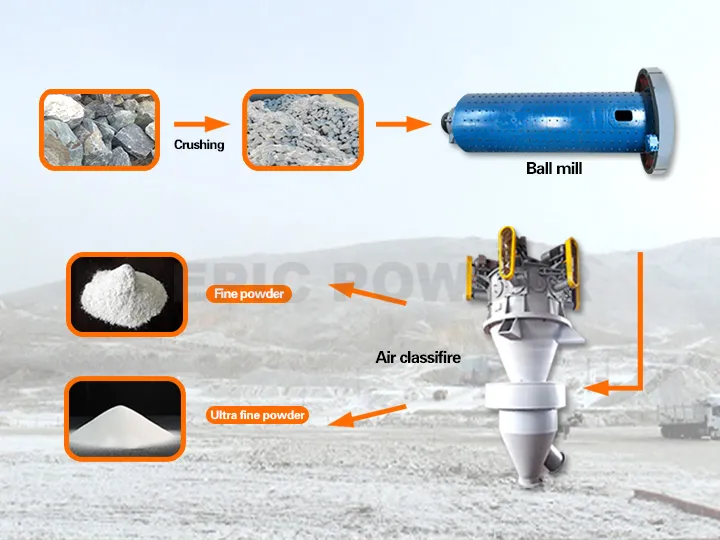
Ball mill with air classifier. A dry circuit with steel media and high tonnage. The 볼밀 및 공기분류기 생산 라인 grinds, then pulls finished powder out while returning coarse to the mill. Media wear shows up as iron in the product. That matters when the same line also serves glass or filler customers.
Vibration mill. 에이 special vibration mill delivers a narrow distribution with low iron pickup when the chamber is lined. Capacity sits below a ball mill circuit, which suits 200 and 325 mesh grades at moderate tonnage.
Fluidized bed jet mill. No grinding media touches the powder, so contamination stays at the level of the feed and the liner. A 수평 유동층 제트 밀 or a vertical fluidized bed jet mill holds the tightest top cut. Energy per ton is the highest of the three. That price is justified when the spec lists iron, or when one line must serve several markets.
| Circuit | Typical top cut | Tonnage | Contamination | When it wins |
|---|---|---|---|---|
| Ball mill + air classifier | 100 to 325 mesh | 높은 | Iron from media wear | One grade at high volume |
| 진동밀 | 200 to 325 mesh | 중간 | Low with lined chamber | Narrow band, iron-sensitive buyer |
| 유동층 제트 밀 | Down to 45 µm and finer | Medium to low | Very low | Purity-critical grades, several products on one line |
Where Yield Is Won: The Classifier
Grinding makes powder. The classifier sets how much of it leaves as product.
A cut that wanders coarse produces oversize, and oversize becomes rework or a rejected lot. A cut that runs fine wastes energy and pushes good product into the fines bin. Both directions cost yield on every ton.
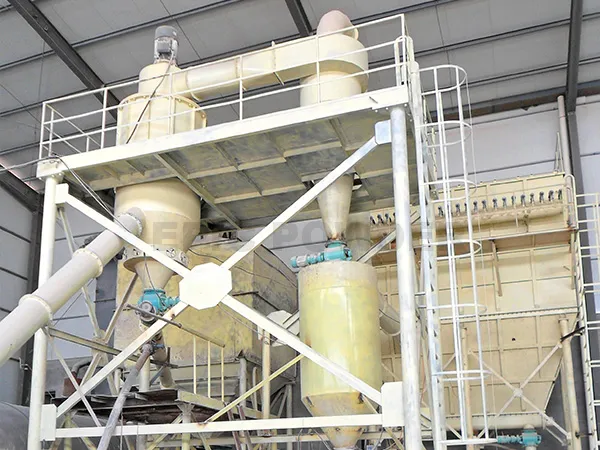
에이 centrifugal air classifier holds the cut at full tonnage. Rotor speed sets D97. The same unit can run 200 mesh for one order and 325 mesh for the next without a rebuild. A 수직형 공기 분류기 covers producers who need a compact unit ahead of the bag filter.
그만큼 quartz ore crushing and grinding guide covers the steps before the mill. The quartz sand types and purity grades overview covers what different deposits can support.
What to Put in an Inquiry
| Input | Why it changes the design |
|---|---|
| Target mesh and D97, plus the residue limit on the control sieve | Sets the classifier cut and the required top-cut sharpness |
| Tonnage per shift and how many grades run on one line | Decides mill size and whether grade changes must happen without stopping |
| Iron or whiteness limit | Rules out steel media or points to a lined or jet circuit |
| Feed form: dry sand, wet filter cake, or purchased flour for re-classification | Decides the drying and feeding arrangement ahead of the mill |
| Existing lab data: PSD curve, residue, iron | Shows which cut the current circuit is losing and where the gain sits |
Those five numbers let us size the circuit on measured data. A target printed on a bag only tells us where to start. Send us your spec and feed data for a circuit proposal. The equipment range lists the machines behind each stage. The sieve number on the bag is a label. The residue on the control sieve decides acceptance.
EPIC 분말 기계
We supply the grinding and classification equipment described on this page. The range covers fluidized bed jet mills, air and centrifugal classifiers, ball mill lines and vibration mills. Every project starts with a material test. We size each machine from the feed data and the target distribution. The proposal covers the circuit from feed point to finished powder.
Send a sample and a spec sheet to mineral@epic-powder.com, or use the contact form.

읽어주셔서 감사합니다. 제 글이 도움이 되셨으면 좋겠습니다. 아래에 댓글을 남겨주세요. EPIC Powder 온라인 고객 담당자에게 문의하실 수도 있습니다. Molly 추가 문의사항이 있으시면 연락주세요."
— 에밀리 첸, 엔지니어