Escolher a granulometria errada para o pó de quartzo causa problemas reais na linha de produção. Pó muito grosso deixa as peças fundidas ásperas e os painéis cheios de poros. Pó moído muito fino entope as linhas de alimentação e dobra seus custos. Este guia explica o que significa a granulometria, como convertê-la para mícrons e qual tamanho de partícula é o ideal para cada aplicação.
O que significa tamanho da malha?
A granulometria da malha indica o número de aberturas em uma peneira dentro de uma polegada linear. Um pó com granulometria de 200 mesh passa por uma peneira que possui 200 aberturas por polegada. A regra é simples: um número de mesh maior significa partículas mais finas, e um número de mesh menor significa partículas mais grossas.
A indústria também estabelece uma linha divisória pelo número da malha:
a. Até 120 mesh é geralmente chamado de areia de quartzo.
b. Acima de 120 mesh é chamado pó de quartzo, também conhecida como farinha de sílica ou sílica moída.
O pó de quartzo possui algumas propriedades fixas que vale a pena conhecer antes de escolher a sua pureza. É composto principalmente de dióxido de silício (SiO₂), com dureza 7 na escala de Mohs e densidade de 2,65 g/cm³. Funde entre aproximadamente 1650 e 1750 °C, resiste a ácidos e álcalis, possui propriedades isolantes elétricas e um baixo coeficiente de expansão térmica. A pureza é classificada em graus comuns: 90–991 TP3T, refinado 99–99,51 TP3T, alta pureza 99,5–99,91 TP3T e ultra-alta pureza ≥99,991 TP3T.
Tabela de conversão de malha para mícron
A medida em mesh e em microns mede a mesma coisa, mas em direções opostas. Enquanto a medida em mesh conta as aberturas por polegada, a medida em microns mede o tamanho da abertura da própria partícula. A tabela abaixo mostra as classes comerciais mais comuns e onde cada uma é utilizada.
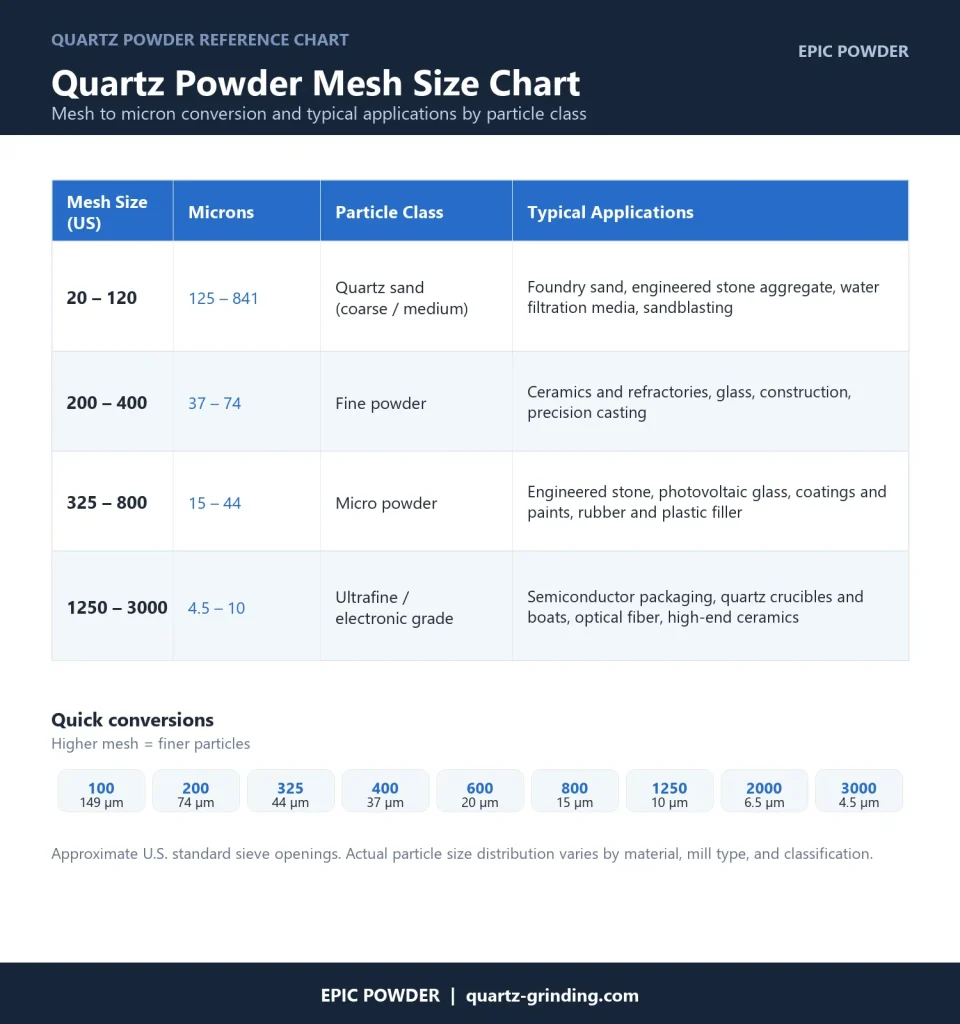
Referência rápida para valores individuais: a malha 100 corresponde a aproximadamente 149 mícrons, a malha 200 a aproximadamente 74 mícrons, a malha 325 a aproximadamente 44 mícrons, a malha 400 a aproximadamente 37 mícrons, a malha 600 a aproximadamente 20 mícrons, a malha 800 a aproximadamente 15 mícrons, a malha 1250 a aproximadamente 10 mícrons, a malha 2000 a aproximadamente 6,5 mícrons e a malha 3000 a aproximadamente 4,5 mícrons. Esses são valores aproximados de peneiras padrão dos EUA.
Selecionando pó de quartzo por granulometria
O pó de quartzo comercial é geralmente vendido em algumas faixas padrão: 325, 600, 800, 1250 e 2000 mesh, com granulometrias de 3000 mesh e nanométricas disponíveis sob encomenda.
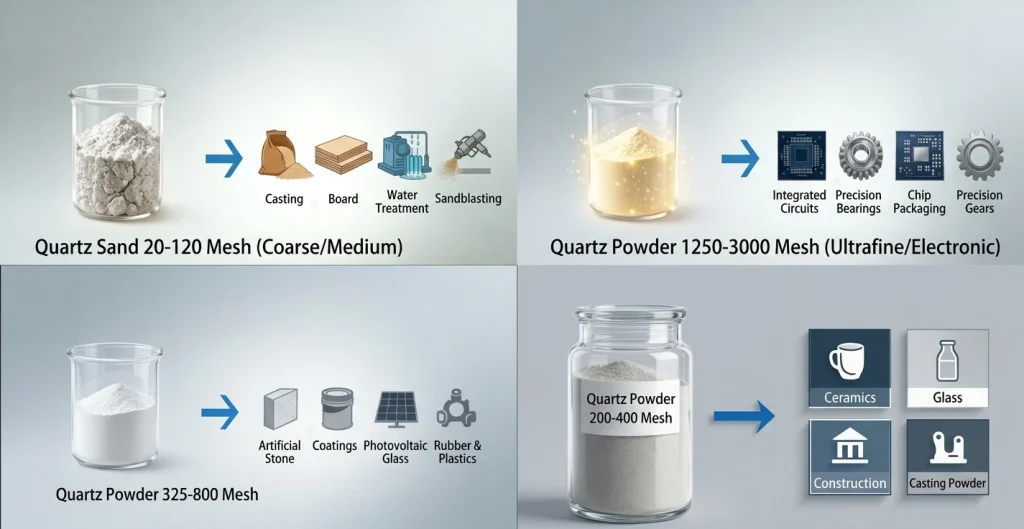
20 a 120 mesh: areia grossa e média
Tecnicamente, esta gama de produtos é composta por areia, e não por pó, mas situa-se no topo da mesma cadeia de abastecimento e geralmente é adquirida em conjunto.
a. Para peças fundidas de grande porte, utilize malhas de 20 a 60 para garantir boa permeabilidade a gases e colapsibilidade.
b. Os processos de fundição de precisão e de espuma perdida utilizam malhas de 60 a 120 para um acabamento de superfície mais liso.
c. A pedra de quartzo industrializada utiliza granulometria de 80 a 120 como agregado principal, misturada com areia grossa de 40 a 60 mesh e partículas finas de 150 a 200 mesh para equilibrar resistência, densidade e uma superfície limpa.
d. A filtração de água utiliza malhas de 20 a 80, com malhas de 20 a 40 como camada de suporte inferior e malhas de 40 a 80 como camada superior fina. Os sistemas de água ultrapura chegam a utilizar malhas de 80 a 120.
e. Para jateamento de areia e enchimento de grama artificial, utilize malha de 10 a 40.
200 a 400 mesh: pó fino
Acima da granulometria 120, você entra no território do pó de quartzo.
a. Na indústria cerâmica e de materiais refratários, é comum o uso de pó refinado de 325 mesh, com classificação acima de 1600 graus Celsius, para massas, esmaltes e tijolos refratários.
b. O vidro plano, o vidro para embalagens e a fibra de vidro utilizam pó de alta pureza com SiO2 em 99,5% ou mais e Fe2O3 em 0,02% ou menos.
c. Misturas para construção civil, com granulometria de 100 a 200 e areia padrão, são utilizadas para concreto de alta resistência, pavimentos permeáveis e contrapisos.
d. A fundição de precisão em pó utiliza granulometria de 200 a 325 para areia de moldagem e abrasivos para jateamento, o que resulta em peças fundidas sem poros.
325 a 800 mesh: micropó
Esta é a faixa de maior volume e onde a diferença de preço entre areia e pó se torna evidente.
a. O quartzo industrializado e o mármore artificial utilizam pó branco puro com granulometria de 325 a 800 mesh e índice de brancura de 95 ou superior. Essa granulometria oferece resistência a manchas, riscos e deformações.
b. O vidro fotovoltaico utiliza malhas de 325 a 800 com SiO2 a 99,8% ou mais.
c. O corte e polimento de wafers de silício utiliza peneira de 800 mesh, também com base na pureza.
d. Revestimentos e tintas utilizam malha 600 para aumentar a dureza da película, a resistência às intempéries e a adesão, para tinta de parede externa e tinta anticorrosiva.
e. A borracha e os plásticos utilizam essa faixa como um reforço que melhora a resistência ao desgaste e reduz o custo.
1250 a 3000 mesh: ultrafino e de grau eletrônico
Nesse nível de precisão, a pureza importa mais do que a malha em si.
a. Em embalagens eletrônicas e laminados revestidos de cobre de alta frequência, utiliza-se uma malha de aproximadamente 3000 com SiO2 a 99,99% ou mais como material de enchimento do núcleo para embalagens de circuitos integrados.
b. Os materiais de suporte para semicondutores utilizam malhas de 1200 a 2000 para cadinhos de quartzo, barcos de quartzo e compostos de encapsulamento de chips.
c. Os materiais de enchimento para fibras ópticas e cerâmicas de alta qualidade utilizam pós de alta pureza e ultra-alta pureza.
d. Os utensílios de laboratório que devem suportar calor utilizam cadinhos de quartzo calcinado e tubos trefilados com classificação acima de 1700 graus Celsius.
e. Componentes especiais para o setor aeroespacial utilizam graus de pureza ultra elevados personalizados para isolamento de alta temperatura e componentes piezoelétricos.
Uma armadilha comum na faixa ultrafina é atingir a granulometria desejada, mas não o limite de Fe₂O₃. Compradores da indústria eletrônica rejeitam o pó devido ao teor de ferro, mesmo quando a granulometria está correta. A qualidade eletrônica é avaliada com base em três fatores: granulometria, pureza e teor de íons de sódio e potássio. A granulometria sozinha não é suficiente.
Pureza e distribuição do tamanho das partículas importam mais do que um único número de malha.
A distribuição do tamanho das partículas é mais importante do que qualquer valor de malha individual. Um pó com distribuição uniforme e precisa flui bem, não forma pontes nem entope as linhas de alimentação e sinteriza ou mistura sem problemas. Misturas, como pedra artificial feita com partículas de 40, 80 e 150 mesh, resultam em uma composição mais densa do que uma mistura de partículas de tamanho uniforme e resistem a rachaduras.
O pó de quartzo não é necessariamente melhor quando mais fino, nem mais barato quando mais grosso. A classificação por granulometria grossa é feita com base na permeabilidade e resistência, a intermediária na brancura e na perda por ignição, e a ultrafina na pureza e no teor iônico. Defina primeiro a aplicação, depois a granulometria e, por último, a pureza, nessa ordem.
Como cada tamanho de malha é produzido

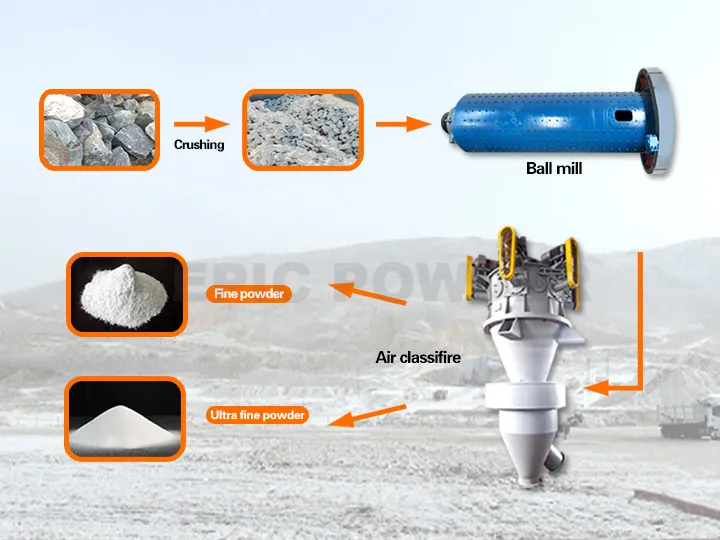
O quartzo é moído de grosso a fino com diferentes equipamentos, dependendo do objetivo. A areia grossa é obtida por britagem e peneiramento convencionais. Para se obter pó fino, é necessário moagem e classificação. Já para se obter pó micro e ultrafino, são utilizados processos de classificação por ar e moagem por jato de ar.
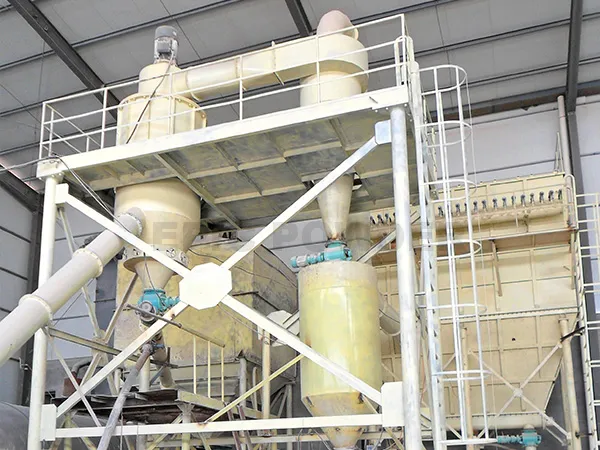
a. A granulometria de 200 a 400 mesh é produzida de forma eficiente por um linha de produção de moinho de bolas e classificador de arO moinho tritura o material e o classificador retorna as partículas maiores para uma segunda passagem, o que mantém a distribuição uniforme.
b. A classificação por malha de 325 a 800 depende da classificação por ar. Ambos classificadores de ar horizontais e classificadores de ar verticais Separar as partículas finas da fração grossa garante que o pó atenda a uma especificação rigorosa. Um moinho vibratório especial também é adequado para moagem fina e ultrafina nessa faixa.
Aproximadamente entre 1250 e 3000 mesh é a faixa de granulometria dos moinhos de jato de leito fluidizado. moinhos de jato de leito fluidizado horizontal e moinhos de jato de leito fluidizado vertical O quartzo é moído por impacto partícula a partícula usando ar comprimido. Isso evita a contaminação e garante a pureza exigida por aplicações eletrônicas e ópticas.
Perguntas frequentes
Para que serve o pó de quartzo de 325 mesh?
Cerâmicas, refratários, pedra de quartzo industrializada, vidro fotovoltaico e revestimentos. É um dos tipos de pó fino mais comuns.
Quantos mícrons corresponde a uma malha 200?
Aproximadamente 74 mícrons. A malha 325 tem cerca de 44 mícrons e a malha 800 tem cerca de 15 mícrons.
O pó de quartzo é o mesmo que a farinha de sílica?
Sim. Farinha de sílica, sílica moída e microsílica referem-se ao pó de quartzo finamente moído, geralmente com granulometria superior a 120 mesh.
Qual a diferença entre o pó de quartzo de 325 mesh e o de 800 mesh?
Tamanho das partículas. A malha 325 corresponde a cerca de 44 mícrons e a malha 800 a cerca de 15 mícrons. A malha 800 é mais cara e utilizada quando se exige um tamanho de partícula mais fino ou maior brancura e pureza.
Como é produzido o pó de quartzo de 2000 mesh?
Utilizando um moinho de jato de leito fluidizado e classificação por ar, o ar comprimido impulsiona as partículas, fazendo com que atinjam tamanhos de alguns mícrons sem contaminação por metais.
Qual o grau de pureza necessário para o pó de quartzo de grau eletrônico?
Normalmente, utiliza-se SiO2 com pureza de 99,99% ou superior, com controle rigoroso de Fe2O3 e de íons de sódio e potássio. O tamanho da malha, por si só, não é suficiente para a eletrônica.
Principais conclusões
a. A malha indica o número de aberturas da peneira por polegada linear. Um número de malha maior significa um pó mais fino.
b. Acima de 120 mesh é pó de quartzo; abaixo, geralmente é areia de quartzo.
c. Escolha a banda de abrasividade adequada para cada aplicação: grossa para fundição e filtração, fina para cerâmica e vidro, micro para pedra artificial e revestimentos, ultrafina para eletrônica.
d. Na granulometria mais fina, a pureza e a distribuição do tamanho das partículas importam mais do que um único número de malha.
e. Cada banda requer equipamentos diferentes de moagem e classificação.
Precisa de ajuda para encontrar a malha e o equipamento certos para o seu material? Entre em contato com o pó EPIC. Para realizar um teste de moagem e obter uma recomendação de moinho ou linha de produção para o seu quartzo.

Obrigado pela leitura. Espero que meu artigo tenha ajudado. Deixe um comentário abaixo. Você também pode entrar em contato com o representante de atendimento ao cliente da EPIC Powder online. Zelda Para quaisquer outras dúvidas.”
— Emily Chen, Engenheiro