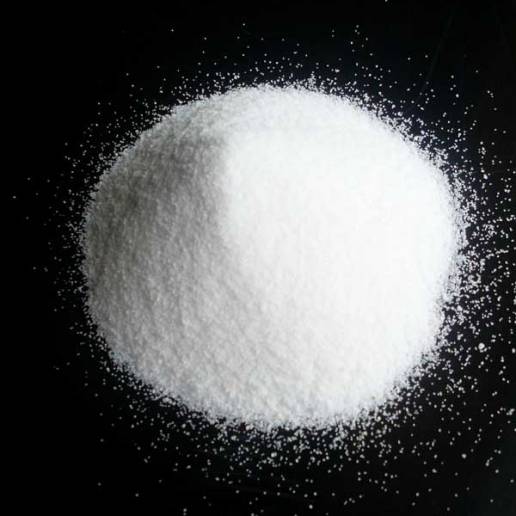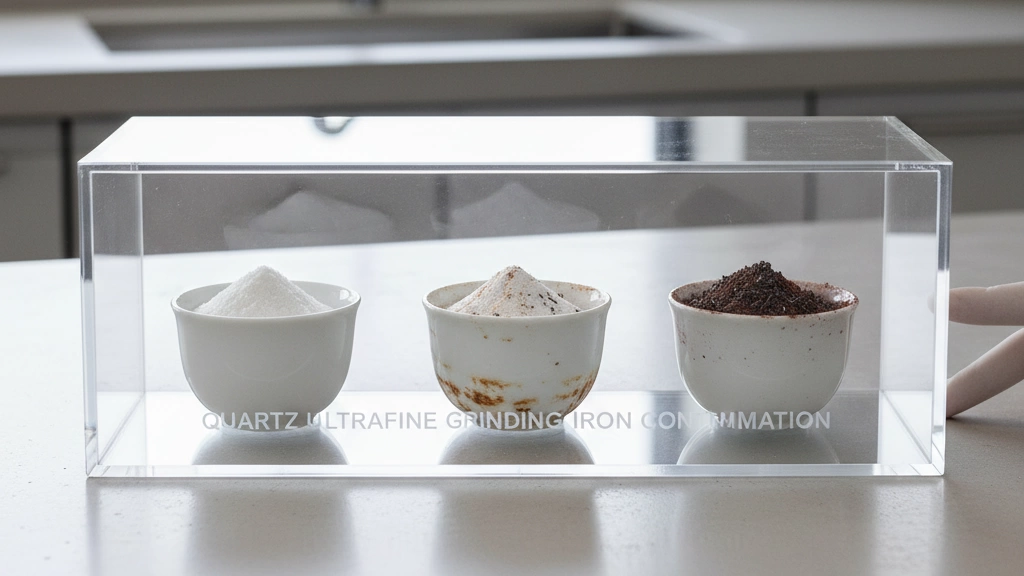
A quartz crucible fails for two reasons: trace impurities destabilize the silica glass, or poorly graded size bands leave voids in the wall. During Czochralski (CZ) silicon pulling, furnaces hold molten silicon above 1,420 °C for days, and the fused quartz sand itself forms the containment vessel. A weak or devitrified wall cracks mid-pull, costing an entire single-crystal ingot. This guide breaks down the particle size bands crucible quartz sand requires, the grinding and classification circuits that produce each band without iron pickup, and the metrics a pilot trial must verify.
What Crucible Quartz Sand Must Deliver
Semiconductor and solar crucible specifications center on three non-negotiable numbers: total elemental impurities, particle size distribution (PSD), and moisture. Total metallic impurities—primarily alkali metals (Na, K, Li), iron (Fe), and aluminum (Al)—typically must stay below 30 to 50 ppm, while ultra-pure inner-layer grades demand under 15 to 20 ppm. Alkali ions act as nucleating agents that trigger devitrification, turning transparent vitreous silica into brittle cristobalite at furnace temperatures. Melt chemistry determines whether the crucible survives the campaign, while particle packing determines whether it forms without defects.
To achieve maximum green density before arc-fusion, crucible sand is blended across two functional fractions:
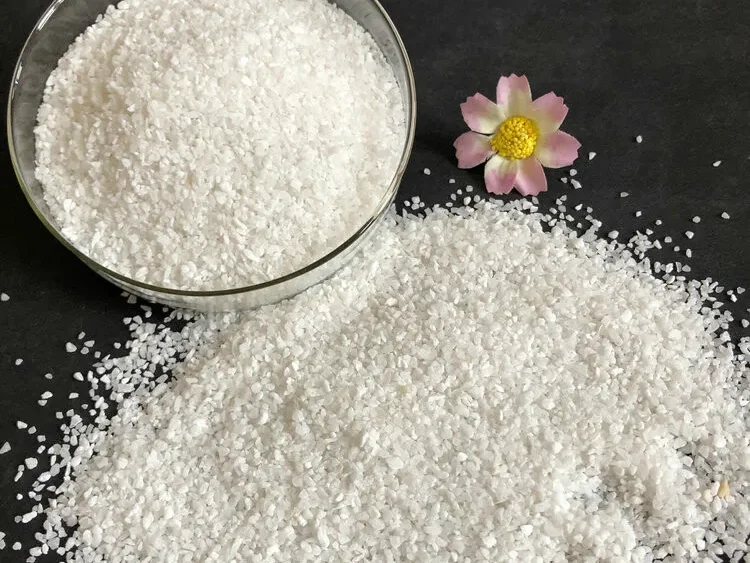
- Structural framework sand (45 to 300+ µm / 50 to 325 mesh): Coarse, angular-to-sub-angular grains form the load-bearing skeleton of the crucible wall and hold shape during vacuum molding and sintering. Check our quartz mesh-to-micron conversion chart for exact sieve equivalents across grades.
- Interstitial filler powder (below 45 µm / -325 mesh): Micronized fines pack into the voids between coarse grains, controlling bulk tap density and gas permeability during vacuum arc melting.
Across both fractions, residual moisture must stay below 0.1% to 0.5%. Trapped moisture flashes into steam under the electric arc, leaving micro-bubbles in the inner wall that erode into the silicon melt.
Which Machine Makes Which Size Band
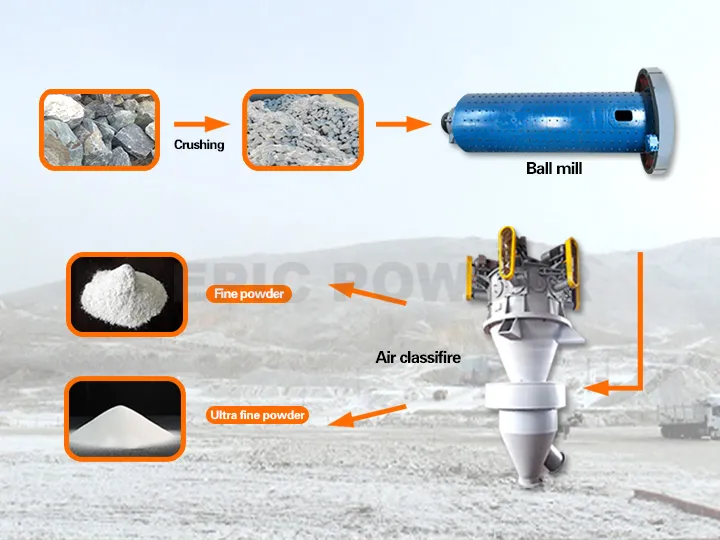
Coarse framework sand does not come from fine grinding. High-purity quartz lumps are crushed, acid-washed, and milled just enough to liberate single crystal grains along natural boundaries, followed by multi-deck screening and air classification. Producing the 50–325 mesh bands is a precision classification job—over-grinding simply wastes yield into excess fines.
The fine filler fraction requires dedicated micronization, where equipment selection balances energy cost against purity:
- 45 to 75 µm (200–325 mesh): A closed-circuit alumina-lined ball mill with an air classifier delivers the lowest cost per ton for the upper filler band.
- 6.5 to 45 µm: A ceramic-lined ring roller mill or air classifier mill (ACM) hits this window with lower specific energy consumption (kWh/ton) than compressed-gas systems.
- D97 2 to 20 µm (Ultra-pure fines): When purity targets allow zero media wear, a fluidized bed jet mill grinds particle-on-particle inside a ceramic-lined chamber with no mechanical grinding parts.
| Crucible Sand Band | Primary Role | Recommended Circuit | Contamination Control |
|---|---|---|---|
| 45 – 300+ µm (50–325 mesh) | Structural wall skeleton | Jaw/cone crushing + vibrating screens + air classifier | Polyurethane screens, ceramic-lined chutes |
| 45 – 75 µm (200–325 mesh) | Coarse void filler | Closed-circuit ball mill + dynamic air classifier | High-alumina liners & grinding media |
| 6.5 – 45 µm | Standard fine filler | Ring roller mill or air classifier mill (ACM) | Alumina/SiC wear parts + ceramic classifier wheel |
| D97 2 – 20 µm | High-purity micro-filler | Fluidized bed jet mill (media-free) | Full ceramic chamber lining + HGMS |
Controlling Iron Pickup Across the Line
Iron enters the product wherever bare steel contacts quartz. At Mohs 7 hardness, quartz abrades standard carbon or manganese steel rapidly, and every worn gram reports directly as metallic Fe contamination. Preventing iron pickup requires a two-step barrier: first, isolating all product-contact zones with high-purity alumina, silicon carbide, or polyurethane linings; second, installing high-gradient magnetic separators (HGMS) after classification to strip paramagnetic minerals and trace wear particles. Our magnetic content reduction guide outlines the exact separator staging for high-purity quartz. A ppm specification your grinding circuit cannot hold is just a number on paper.
Where Wet Grinding Routes Fit
Some integrated crucible manufacturers operate wet ball-milling circuits, preparing aqueous quartz slurries directly ahead of slip-casting or spray-granulation steps. Wet milling suppresses airborne silica dust and feeds wet forming lines seamlessly. However, dry grinding and air classification remain the standard for merchant quartz producers supplying multiple crucible plants, because dry classified bands store, blend, and ship without energy-intensive dewatering and thermal drying stages. See our wet vs. dry quartz grinding comparison for a full cost and purity breakdown.
What a Pilot Trial Must Report
Because natural vein quartz and pegmatite deposits vary widely in grain boundary strength and trace inclusions, a pilot trial on your actual washed feed should verify four baseline metrics before finalizing equipment sizing:
- Full PSD curves per band: Verifying D10, D50, and D97 cut sharpness and fines yield across each screen and classifier cut.
- Elemental pickup (ΔFe, ΔAl, ΔZr): ICP-OES chemical analysis before and after milling to confirm zero net metallic contamination from liners or media.
- Final moisture & flowability: Confirming post-drying moisture below 0.1%–0.5% and consistent bulk tap density.
- Whiteness & bubble test performance: Optical whiteness plus vacuum-fusion bubble checks required by downstream crucible makers.
Real test data from your own quartz ore sets the final flowsheet and quote.
Frequently Asked Questions
Can one mill produce the entire crucible sand blend?
No. Coarse structural bands (50–325 mesh) require controlled liberation and multi-stage classification to avoid generating excess dust, whereas the sub-45 µm filler fraction requires dedicated micronization in a ceramic ball mill, roller mill, or jet mill. Producing both on a single machine sacrifices yield and ruins the packing curve.
Why does alkali content matter more than whiteness?
A quartz sample can look bright white at room temperature while still carrying trace sodium or potassium inside fluid inclusions or feldspar impurities. Above 1,400 °C, those alkali ions accelerate crystallization (devitrification), weakening the crucible wall. Whiteness helps qualify raw ore, but ICP chemical purity governs furnace life.
Is crucible sand the same as fused silica powder?
Not always. Natural crucible quartz sand retains its crystalline alpha-quartz structure and fuses into glass in situ during the crucible arc-melting process. Fused silica powder has already been melted into amorphous glass before grinding, giving it near-zero thermal expansion. Review our crystalline quartz vs. fused quartz guide to match the feedstock to your process.
Epic Powder
Epic Powder designs grinding and classifying systems for minerals, chemicals, food, and pharmaceuticals. With more than 20 years of powder processing experience, we match the right mill to your target particle size and capacity. Tell us about your material and we will recommend a tested solution.

“Thanks for reading. I hope my article helps. Please leave a comment down below. You may also contact EPIC Powder online customer representative Molly for any further inquiries.”
—Mr. Wang, Senior Process Engineer