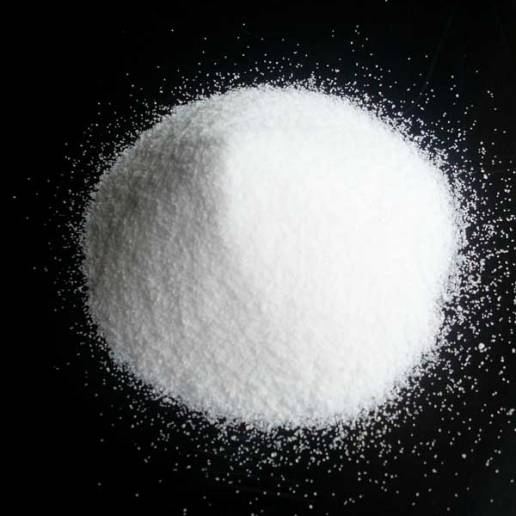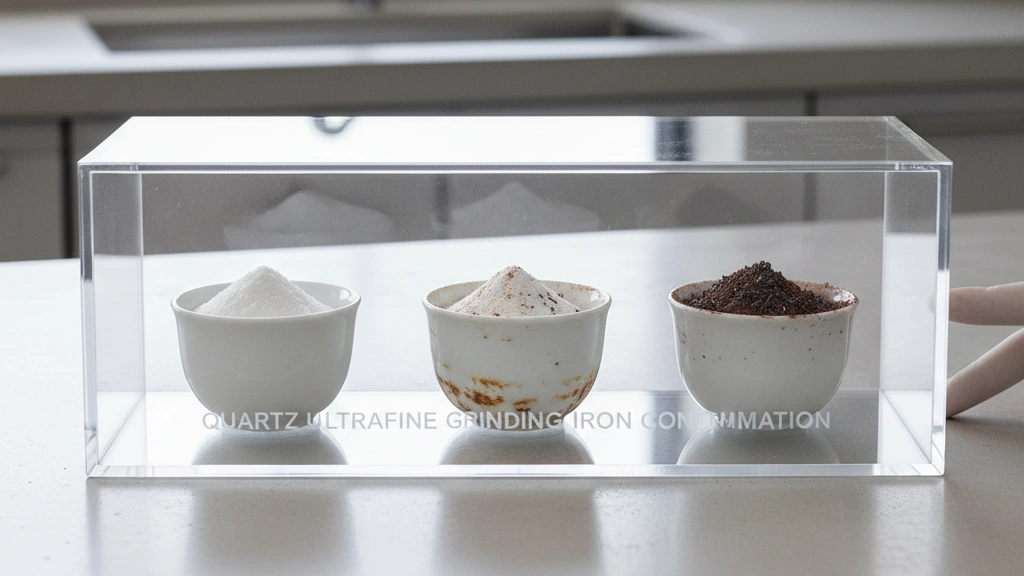
Engineered quartz stone is made by binding quartz sand and quartz powder with an unsaturated polyester resin (UPR). In today’s price-competitive market, resin can account for roughly 60% of raw material cost, so it is the first place manufacturers look when cutting cost without losing quality. Quartz powder matters more in that effort than many producers realize.

1. Why Unmodified Quartz Powder Drives Up Resin Use
Quartz powder is the primary filler, but it has a limitation. Its surface is hydrophilic, while the resin system is organic and non-polar. Unmodified quartz powder carries reactive silanol groups (Si-OH) on its surface, which give the powder a strongly hydrophilic, oleophobic character. As a result, the powder is poorly wetted by a non-polar organic resin matrix. It does not disperse evenly and tends to agglomerate. To make these particles flow and pack, manufacturers usually add more resin. This raises cost and, because the powder stays unevenly distributed, creates internal defects that hurt board strength, gloss, and dimensional stability.
The real issue is not the resin or the quartz powder. It is the interface between them.
2. What Surface Modification Actually Does
Surface modification changes the particle’s surface energy so that the resin can wet and coat it. It is not about wrapping the powder in a film. Two routes are used most often:
Silane coupling agents form covalent bonds with organic functional groups on the quartz surface through hydrolysis and condensation. The results last longer, but the process is more complex and costly.
Wetting-dispersion modifiers build a low-surface-energy organic layer on the particle through molecular adsorption and steric hindrance. This physical modification is fast and efficient, which is why it has become the more popular choice in industrial use.
Both routes do the same job. They screen the polar silanol groups and lower the surface energy so the resin can wet and wrap the powder evenly.
3. The Metric That Matters: Oil Absorption Value
Oil absorption value measures how much binder a filler needs. A higher value means more resin is needed to wet the filler.
Unmodified quartz powder has a polar surface, so resin molecules do not spread over it efficiently. More resin has to be added just to compensate for poor wetting. After modification, this changes:
Lower surface polarity. Contact-angle testing shows a move toward hydrophobic, oleophilic behavior, with contact angles above 110° in well-modified powder.
Better resin wetting. Slurry flow improves and coating becomes more uniform.
Less agglomeration. Fewer resin-starved areas form, and the internal structure becomes denser.
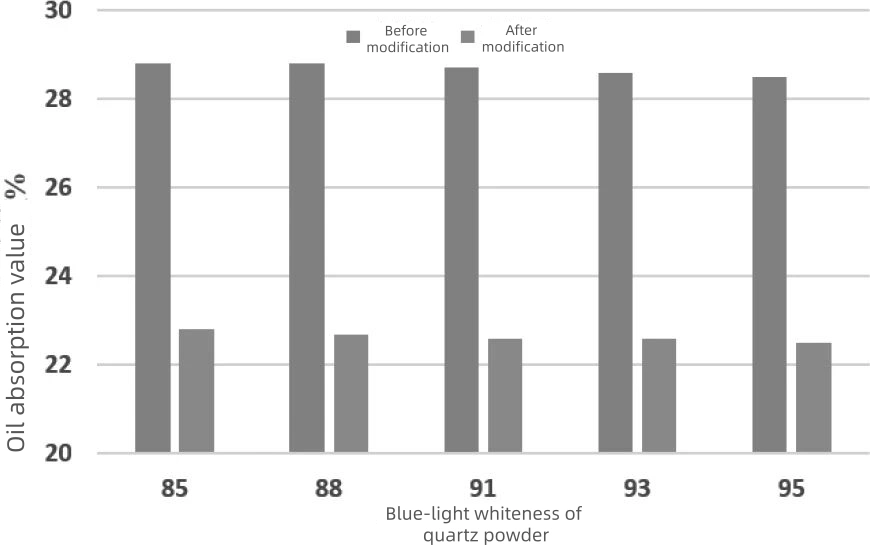
Industrial trials commonly report that a suitable modifier added at 0.3% to 0.5% can bring oil absorption down from around 28% to roughly 22%, a drop of more than 20%. That allows 1.5% to 2% less resin without changing the rest of the formulation.
Based on a production line with an annual output of one million square meters, annual resin cost savings can reach several million yuan. This figure accounts only for direct material costs, excluding latent benefits such as improved yield rates and reduced energy consumption resulting from enhanced dispersion.
4. Integrating Modification into the Grinding Process
A common concern is that modification will add steps and slow the line down. In practice, dry surface modification can be built into the existing milling flow instead of running as a separate stage. The modifier is sprayed onto the quartz sand through atomizing nozzles before or as it enters the ball mill. During grinding, mechanical force spreads the modifier evenly, so the coating finishes inside the mill. There is no drying, washing, or extra aging step, and the dosage per tonne of powder stays very low. The right grinding system makes this work. Epic Powder Machinery’s ball mill and air classifier production line is designed for uniform, high-intensity milling and precise classification, so that:
a. the modifier spreads evenly over every particle during grinding, giving a consistent surface coating;
b. the particle size distribution stays stable after modification, which keeps filler performance consistent from batch to batch;
c. the process scales from lab trials to full production without losing coating uniformity.
For ultrafine quartz powder, Epic’s air classifiers and jet mills provide the fine, narrow particle-size control that premium engineered stone and high-purity quartz processing require.
5. The Economic and Quality Payoff
The savings go beyond resin cost. For a line producing one million square meters a year, cutting resin by 1.5% to 2% adds up to significant annual savings, before the indirect benefits are counted:
a. better dispersion raises yield and lowers energy use;
b. fewer internal defects improve board strength, gloss, and dimensional stability;
c. after polishing, the thin organic layer is largely removed, so modified powder shows no measurable color shift or whiteness loss (typically ΔE below 0.5) and still meets premium surface requirements.
Conclusion
Resin is the largest controllable cost in engineered quartz stone, and quartz powder surface modification is one of the most effective ways to reduce it. When dry modification is integrated into grinding and classification, producers get lower oil absorption, better filler-resin compatibility, and measurable resin savings, without adding a separate process step.
To learn how our production line can support integrated surface modification for your quartz or silica powder, contact the EPIC Powder team for a technical consultation and process recommendations.
Epic Powder

“Thanks for reading. I hope my article helps. Please leave a comment down below. You may also contact EPIC Powder online customer representative Zelda for any further inquiries.”
— Jason Wang, Engineer