Dust from quartz grinding raises health, compliance, and equipment concerns. It contains respirable crystalline silica (RCS), which causes silicosis, lung cancer, and chronic obstructive pulmonary disease after long-term exposure. OSHA sets the permissible exposure limit (PEL) for RCS at 50 μg/m³ as an 8-hour time-weighted average. A poorly designed quartz grinding dust collection system exposes a plant to fines, equipment wear, and worker turnover.
Why Quartz Dust Needs Dedicated Control
Hard Particles Accelerate Equipment Wear
Quartz has a Mohs hardness of 7. After grinding, the particles remain sharp and abrasive. They erode duct elbows, fan blades, and filter media faster than ordinary coal or cement dust. Over time, this increases the frequency of repairs such as patching worn elbows, replacing torn bags, and rebalancing fan impellers. Steel-lined ball mills processing quartz for coatings can lose 5–10 whiteness points from iron contamination caused by abrasive wear.
Respirable Dust Is the Real Hazard
Particles below 4–5 μm make up the respirable fraction that reaches the alveoli. The goal of dust control is to keep respirable dust concentrations below the regulatory limit. Making the shop look clean is a side effect. The measure of success is the measured dust concentration. OSHA’s engineering controls for stone-related tasks include wet methods, local exhaust ventilation, and vacuum dust collection systems.
Regulatory Limits Drive System Design
OSHA 29 CFR 1926.1153 sets an action level of 25 μg/m³ and a PEL of 50 μg/m³ for RCS in construction. EU Directive (EU) 2017/2398 sets an occupational exposure limit of 0.1 mg/m³ for respirable crystalline silica. China also has exposure limits for silica dust in workplaces. Export-oriented plants must meet both destination-country and local requirements.
Core Components of a Silica Dust Control System
Capturing Dust at the Source
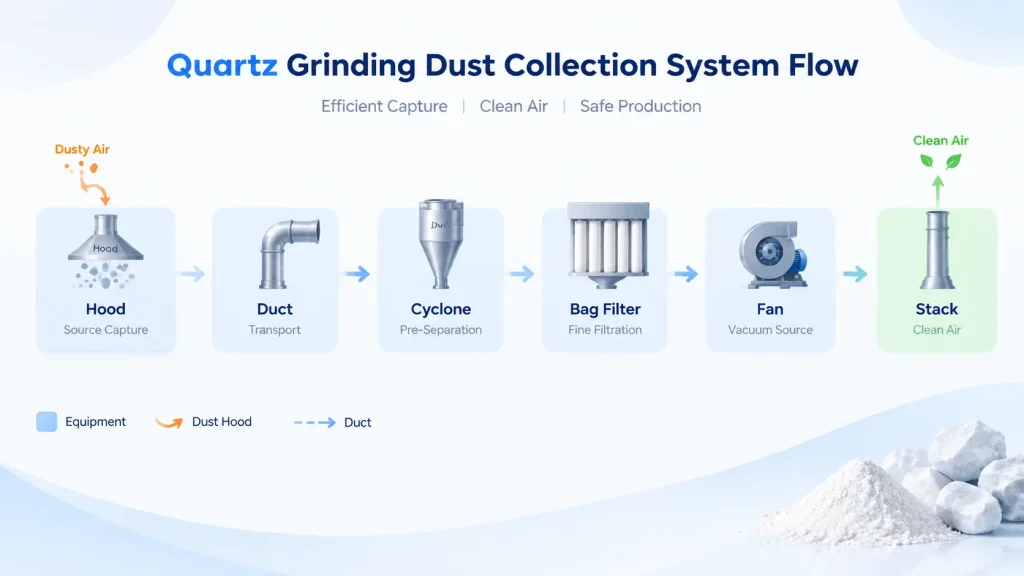
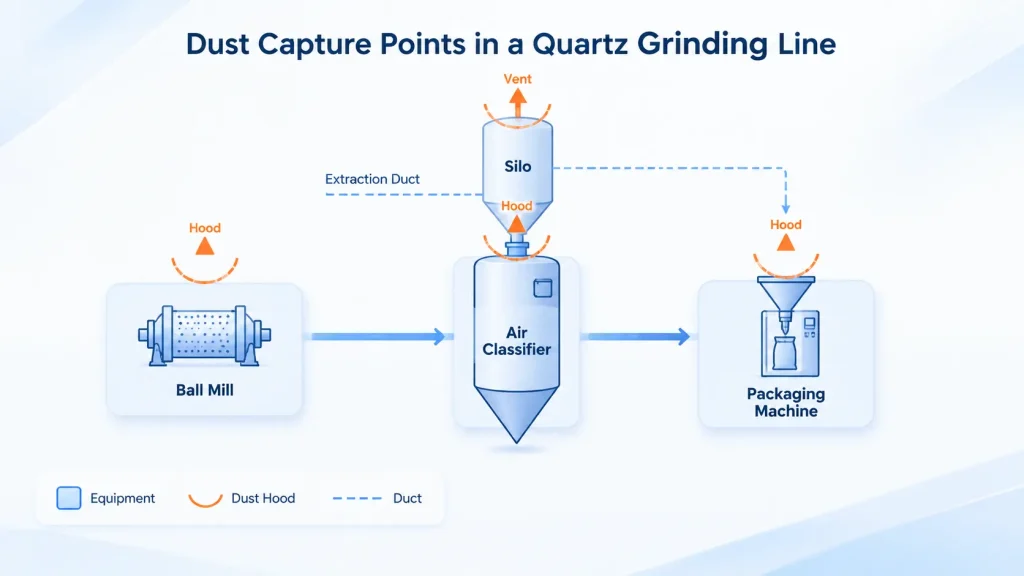
Dust hoods at every transfer point prevent silica from entering the plant air. Ball mill feed and discharge openings, classifier fines outlets, silo vents, and packaging machine discharge points all need local hoods. If face velocity is too low, dust escapes; if too high, the hood pulls usable product out of the process. A face velocity above 0.5–1.0 m/s is common, with the exact value depending on particle size and hood geometry.
Ductwork and Abrasion Resistance
Duct layouts should minimize horizontal runs and sharp bends. Quartz dust that settles in horizontal ducts forms an abrasive layer that accelerates wall wear. A conveying velocity of 18–22 m/s usually transports the dust without excessive erosion. Wear liners or large-radius elbows help at high-wear points.
Cyclone Pre-Separation
Cyclones remove coarse abrasive particles before they reach the final filter. They use centrifugal force to separate particles above 10–20 μm, which reduces the load on downstream media. For highly abrasive quartz dust, this step extends bag or cartridge life and reduces downtime for filter replacement.
Final Filtration Unit
This stage catches the fine fraction that cyclones cannot remove. Selection depends on dust loading, floor space, maintenance access, and emission limits. Silica dust control systems typically need filtration efficiency of at least 99.97% at 0.3 μm. PTFE membrane bags or anti-static media are common in quartz applications.
Fan and Negative Pressure Control
The fan and variable-frequency drive set the system vacuum. The whole production line should run under slight negative pressure so dust does not leak through gaps. Epic Powder’s FAQ states that its lines use large-capacity dust collectors with a removal rate up to 99%. A VFD adjusts airflow to match line load and avoids wasting power during low-load operation.
Explosion Protection
Silica dust is combustible when dispersed in air. A silica dust control system needs explosion vents, isolation valves, and rotary airlocks sized for the dust deflagration index (Kst). Collectors without these safeguards can turn a compliance issue into a safety incident.
Filter Media Selection Determines Operating Cost
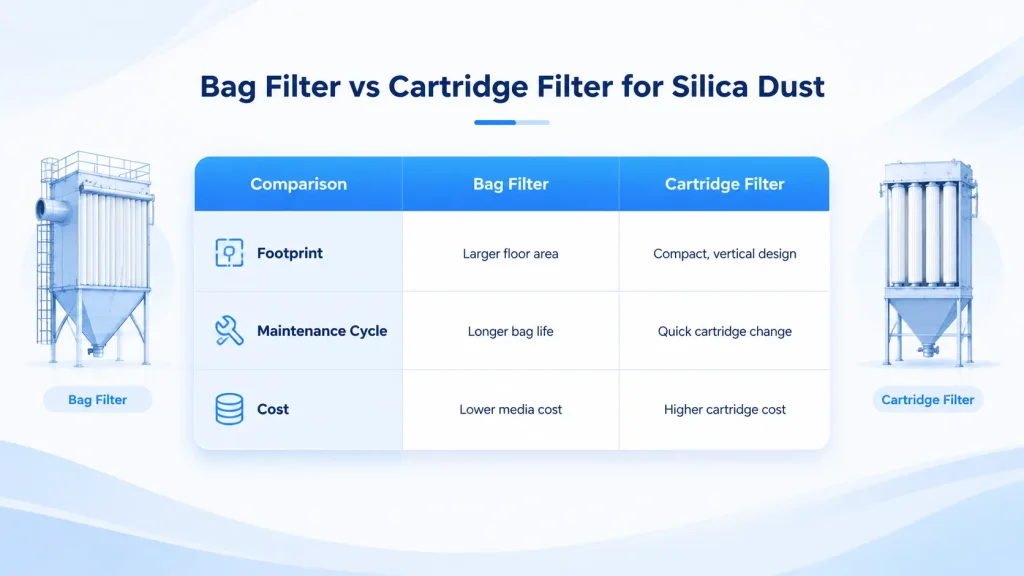
Temperature, flex fatigue, and micron rating decide which media lasts in quartz service. Quartz grinding temperatures are usually moderate, but pulse cleaning bends the media repeatedly. Standard polyester needle felt costs less but wears faster under heavy abrasion. PTFE membrane bags have a smooth surface and good cake release, making them better for fine, concentrated silica dust.
Cartridge collectors save floor space and allow quick filter changes, which suits tight layouts. Baghouses handle higher airflow and offer more media choices, which suits high dust loads. For quartz powder with D97 between 10 and 45 μm, filter air-to-cloth ratios typically stay around 0.8–1.2 m/min.
Integration with Ball Mill and Classifier Lines
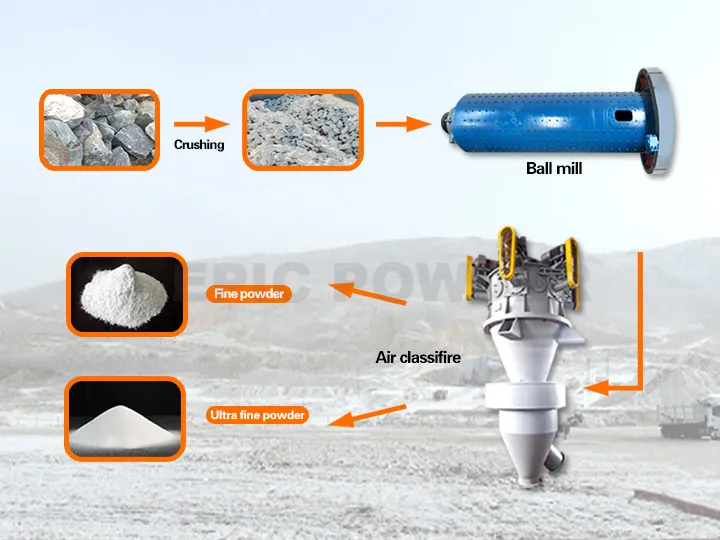
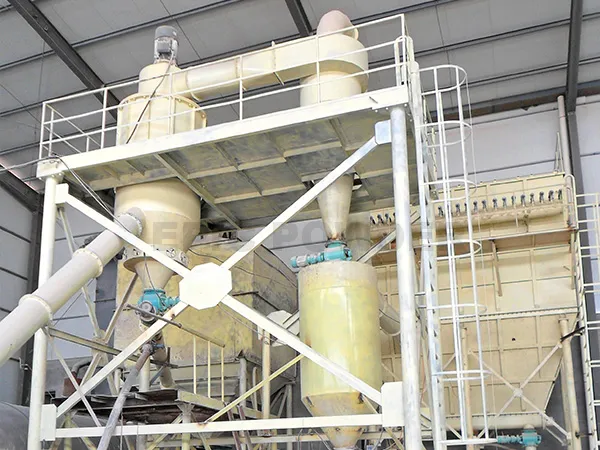
Each unit operation in a ball mill-classifier line creates its own dust source. The mill feed and discharge, the classifier product outlet, and the cyclone collector all need separate extraction. Connecting multiple points to one common header without individual airflow calculations creates uneven distribution; some points end up with insufficient suction.
Airflow inside the classifier is process air. Pulling directly from the classifier body would change the cut point and ruin classification accuracy. Extraction points should be at the classifier product outlet and silo vents, not inside the classification zone. Epic Powder’s ball mill and air classifier production line includes dust collection connection flanges at equipment interfaces, making it easier to connect a central dust collection system.
Common Design Mistakes
Plants often size the collector too small or ignore abrasive wear in ducts. Other frequent errors include selecting filters based only on price and omitting differential pressure monitoring. Buying the dust collector as a standalone unit after the production line is already laid out causes another set of problems: long duct runs, too many elbows, and insufficient vacuum. Fixing these issues on site costs more than planning the system during layout.
Dust Control Belongs in Line Design
A silica dust control system is not optional for a quartz grinding plant. Regulatory limits, equipment life, and worker health all require source-based design. Plants that plan dust collection into the line layout typically spend less on duct rework, filter replacement, and regulatory penalties than plants that add a collector after installation.
Get a Dust Control Layout for Your Quartz Line
A well-planned quartz grinding dust collection system starts with the line layout. Send Bột Epic your capacity, target fineness, and local emission standard. The team will make a plan for your ball mill and air classifier line.
Máy móc bột Epic
Máy móc bột Epic designs and manufactures powder processing equipment for minerals, chemicals, battery materials, and other industrial applications. Our product range includes ball mill and air classifier production lines, jet mills, impact mills, and air classifiers. Our team has more than 20 years experience in various powders processing. We supply both single machines and integrated grinding-classification systems, with engineering support for layout, commissioning, and after-sales service.

Cảm ơn bạn đã đọc. Tôi hy vọng bài viết của tôi có ích. Vui lòng để lại bình luận bên dưới. Bạn cũng có thể liên hệ với đại diện khách hàng trực tuyến của EPIC Powder Zelda để biết thêm bất kỳ thông tin nào khác.”
— Jason Wang, Kỹ sư